
"What-Aboutism" as Colonial Technology: A Guide for First Nations Peoples
By Jayde Fuller
Suggested Citation
Fuller, J. (2026). "What-aboutism" as colonial technology: a practical guide for First Nations People - how deflection operates as an automated defence system and how to respond from sovereignty. Indigenous Regulatory Practice. https://doi.org/10.5281/zenodo.18948592
Abstract
What-aboutism deflection is not a communication failure. It is colonial technology - an automated institutional defence that activates when First Nations Peoples name specific harm and demand specific accountability. This piece argues that what-aboutism functions as a discursive mechanism with identifiable patterns, a documented history, and measurable consequences: in the 18 months following the Voice to Parliament referendum, over half of Aboriginal and Torres Strait Islander adults experienced discrimination when seeking healthcare. Discrimination is escalating - not improving - precisely as the frameworks designed to address it are being diluted.Drawing on Daniels’ structural harm frameworks, the documented co-optation of Dr Irihapeti Ramsden’s cultural safety into a universal one, and current Mayi Kuwayu data, this piece maps five patterns of what-aboutism, traces their institutional logic, and provides eight sovereignty-based responses for First Nations Peoples who choose to engage them. It closes with a direct address to the institutions and individuals producing the deflections it names.On January 26th, a white supremacist threw an explosive device into a crowd of Aboriginal and Torres Strait Islander Peoples in Perth, marching to change the date of Australia Day – “the anniversary of invasion, dispossession, and the beginning of policies that sought to erase us (Murray, 2026).”
A week and a half passed before authorities called it terrorism. The perpetrator remained unnamed "for his safety” - what Mununjahli and South Sea Islander Prof Chelsea Watego (2017) identified eight years earlier as “the privilege of white murderers of Black children: protection through anonymity while victims remain unknown.” Only after sustained pressure from Indigenous communities was the terrorist identified as Liam Alexander Hall (Torre, 2026).
The Bondi terrorists (Doherty et al., 2025) - brown men - were named within hours.
The responses that followed were predictable and cutting:
— "What about other communities?"
— "The bomb should have gone off."
— "He's a one off - he's been radicalised."
— "Who cares?"
Race determined who got called a terrorist immediately and who didn't. Race determined who received institutional protection and who was exposed. Race determined whose lives were grievable.
If you are an Indigenous person and you have ever raised specific harm against your communities only to have someone immediately redirect to other issues, other groups, other concerns - you know this pattern.
It has a name: "what-aboutism" deflection, or as I colloquially call it, the Shannon Noll effect (for non-Australians, this references a singer who famously covered the ‘Moving Pictures’ song "What About Me?"). And it's not random. It's colonial technology operating with precision to prevent the specific accountability you are demanding.
This guide gives you the tools to recognise it, understand what is actually happening, and respond from a place of sovereignty.
Defining What-Aboutism Deflection
DEFINITION
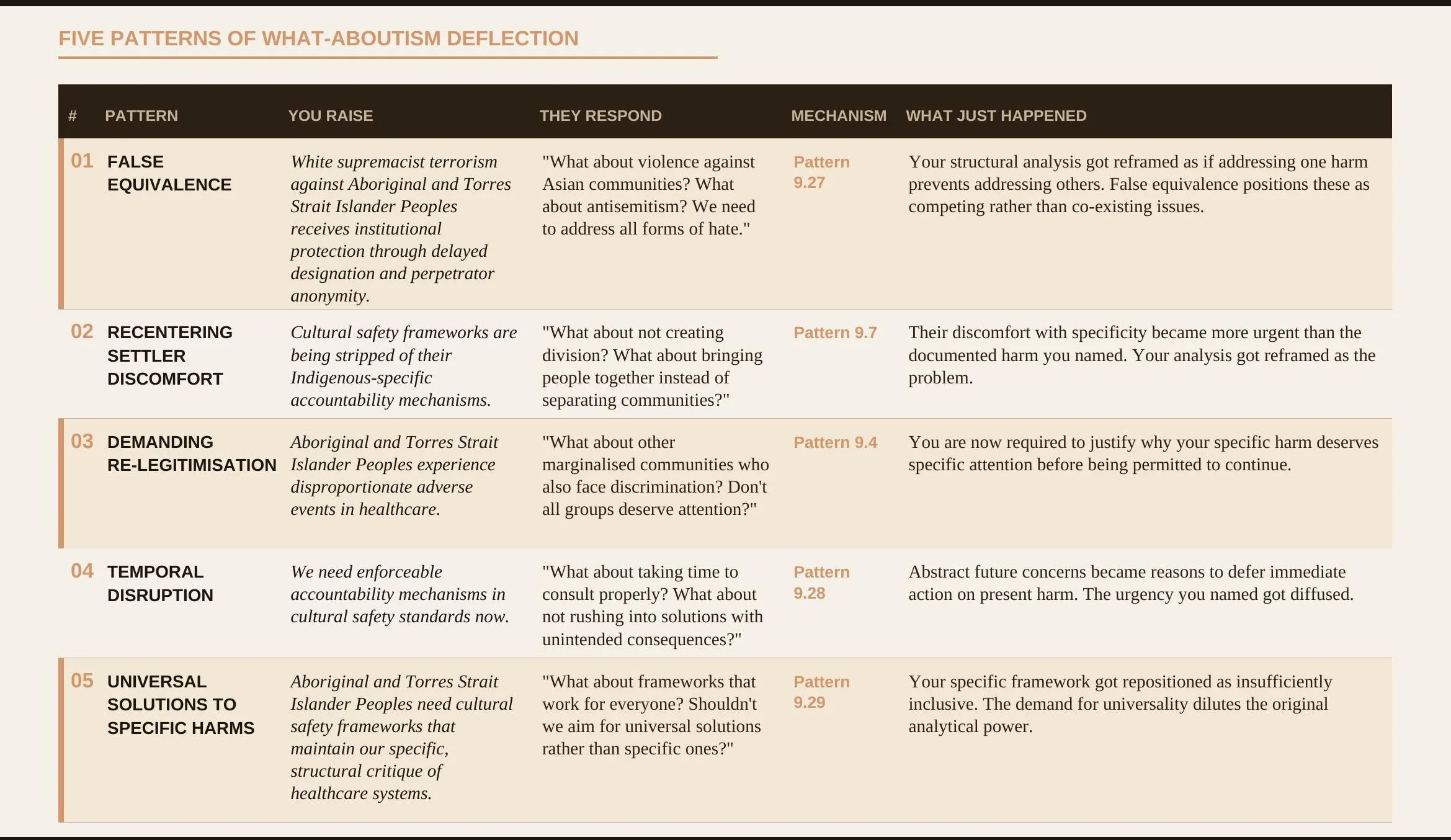
What-aboutism deflection is a discursive weapon that derails specific accountability by redirecting attention elsewhere. It operates as colonial technology: an automated defence system that activates when First Nations Peoples name specific harms and demand specific solutions.
How It Operates
—False equivalence - positioning unrelated harms as competing priorities
— Recentering settler discomfort - making institutional unease more urgent than documented harm
—Demanding re-legitimisation - requiring Indigenous peoples to prove why Indigenous-specific solutions aren't exclusionary
— Temporal disruption - deferring action through concerns about process
— Universal dilution - insisting Indigenous frameworks must apply "to everyone" or they're unfair
What It Achieves
DEPLETION OF ORGANISING CAPACITY
Energy spent re-explaining is energy not spent organising for change.
DEFERRAL
Accountability is perpetually delayed pending "broader consultation."
DILUTION
Indigenous frameworks lose their sovereignty-based power analysis and are repositioned as one consideration among many.
MANUFACTURED ACTIVITY WITHOUT ACCOUNTABILITY
What-aboutism doesn't just exhaust and defer - it generates the appearance of institutional rigour. As Daniels (2025) observes, "recommendations have become a routine way for the [institution] to perform change without undergoing it" (p. 8). What-aboutism is how colonial institutions stay busy without ever having to change.
WHAT IT IS NOT
Genuine questions about implementation, coalition-building dialogue, or good-faith engagement with complexity. The distinction lies in intent and effect: genuine engagement seeks to understand Indigenous frameworks and build upon their structural rigour; what-aboutism deflection seeks to diffuse specificity, defer accountability, and protect white possessive investments in institutions.
This pattern is not random. This is not individuals being thoughtless. This is colonial technology functioning exactly as designed.
This pattern is not random. This is not individuals being thoughtless. This is colonial technology functioning exactly as designed.
How to Recognise What-Aboutism Deflection
Five predominant patterns, each mapped to the institutional mechanisms identified by Dr Shereen Daniels in 30 Patterns of Harm A Structural Review of Systemic Racism within the London Metropolitan Police Service (2025).
What's Actually Happening: The Theory
Scarcity Mindset
Safety is not scarce. Addressing Aboriginal and Torres Strait Islander Peoples’ disproportionate harm in healthcare does not prevent addressing other communities’ needs - it establishes the structural rigour required for everyone.
“For institutional racism to thrive, people need only be "colour blind," "meritocratic," ignore the reality of existing privilege and injustices, and simply let the systems and structures reproduce the status quo.”
- Elias & Paradies (2021, p. 47)
Daniels (2022) names the absurdity of this logic from her own experience of cancer treatment: no other consultant barged into her specialist’s office demanding he turn his attention elsewhere, no nurse complained her tests caused a backlog, and no cardiologist asked “What about my patients?” As she concludes: “Racism needs specific intervention. Taking a generalised approach to specific problems never yields impressive results” (pp. 156-157). The scarcity framing isn’t a reasonable concern about resource allocation. It is a mechanism for protecting institutional comfort at the expense of accountability.
Colonial Reflex
What-aboutism is how colonial powers protect themselves when threatened. When First Nations Peoples name specific harm and demand specific accountability, we threaten institutional arrangements that have never had to centre us. The reflex is automated colonial defence: diffuse our specificity, redirect attention away from structural critique, reframe our analysis as the problem, and exhaust us before we can organise for change.
White Possessiveness As A Foundation
Goenpul scholar Distinguished Professor Aileen Moreton-Robinson names the mechanism beneath this reflex: white possessiveness (2015). She argues that white possession operates at both ontological and epistemological levels. At the ontological level, "to be able to assert 'this is mine' requires a subject to internalise the idea that one has proprietary rights that are part of normative behaviour, rules of interaction, and social engagement" (Moreton-Robinson, 2015, p. 50).
“White possession operates discursively through narratives of the home of the brave and the land of the free… Against this stands the Indigenous sense of belonging, home, and place in its sovereign incommensurable difference.” - Moreton-Robinson (2015, p. 52)
The Co-optation of Cultural Safety: A Documented History
Cultural safety was developed by Ngāi Tahu, Rangitāne nurse Dr Irihapeti Ramsden as a structural critique. It centred Indigenous Peoples' authority to determine what constitutes safety in systems designed to harm us. It demanded institutions examine their own power, not just train practitioners in cultural awareness.
“Cultural safety was developed in the 1980s and 1990s as an Indigenous-led anti-colonial critique of nursing's Anglo-European knowledge base. It represented a bicultural, liberatory framework based on Te Tiriti o Waitangi and the notion of negotiated partnership between Māori as Tangata Whenua (people of the land) and settlers.” - Nurse academic, Dr Ruth De Souza (2026)
Australia now faces the same risk Aotearoa experienced in the 1990s and 2000s. There is growing pressure to broaden cultural safety frameworks beyond their Indigenous-specific foundations. While antisemitism is real and requires action, the solution is not appropriating Indigenous frameworks and stripping them of their sovereignty-based power analysis.
The contradiction is stark: the same Australian institutions resisting Aboriginal and Torres Strait Islander sovereignty claims have no difficulty supporting Zionist settler-colonial projects in Palestine. Apparently, Indigenous sovereignty is divisive when it's ours, but worthy of institutional investment when it's Israel's. This selective application reveals that what-aboutism is not about genuine solidarity - it's about protecting white possession by co-opting our frameworks while funding the dispossession of other Indigenous Peoples.
The colony does not abandon a framework it cannot immediately defeat. It waits. It asks reasonable questions. It broadens, dilutes, and repositions - until the framework that was built to hold it accountable becomes a tool it can use to protect itself. That is what De Souza (2026) documents in Aotearoa. That is what I witnessed across years of regulatory work in Australia. And that is what will happen here if we become complacent.
My parents’ and grandparents’ generation were denied access to culturally safe healthcare. They experienced racism seeking care, and they died in preventable ways because no accountability structure compelled anyone to do otherwise. What the National Law now contains - the principle that Aboriginal and Torres Strait Islander Peoples alone determine what is and isn’t culturally safe - is the structural answer to that. It took collective effort, sustained resistance, and years of fighting the same fight over and over to put it there.
Definition of Cultural Safety (National Law, Australia)
Cultural safety is determined by Aboriginal and Torres Strait Islander individuals, families and communities.
Culturally safe practise is the ongoing critical reflection of health practitioner knowledge, skills, attitudes, practising behaviours and power differentials in delivering safe, accessible and responsive healthcare free of racism. (Australian Health Practitioner Regulation Agency, 2020, p. 9)
We cannot rest on that victory. The definition must be actively defended - in every code review, every standard update, every conversation where someone asks why it can’t apply to everyone. Because the answer to that question is not a bureaucratic technicality. It is sovereignty. And sovereignty, in this country, has never been given. It has only ever been held.
The Documented Timeline of How Cultural Safety Was Stolen
1980s
Dr Irihapeti Ramsden (Ngāi Tahu, Rangitāne) develops Kawa Whakaruruhau ("cultural safety") as Māori-specific structural critique grounded in Te Tiriti o Waitangi. Core principles: Māori authority to determine safety; critical self-reflection by practitioners on their own power; structural transformation, not individual competency checklists.
1992
Nursing Council of New Zealand formally adopts Kawa Whakaruruhau into nursing and midwifery education.
1995
Parliamentary Select Committee investigation triggered by dominant group backlash.
1996
First broadening following external review: "The concept of cultural safety was then developed into a separate and broader philosophical perspective to change its primary focus from Māori and Kawa Whakaruruhau to the inclusion of all minority groups."
2002
Guidelines go further, separating cultural safety entirely from Te Tiriti and Māori health - what De Souza calls "a deflection and deferral of Indigenous sovereignty claims… conflating racialisation and colonisation."
2018
Ahpra introduces cultural safety into nursing and midwifery codes of conduct, 39 years after its development in Aotearoa, in a diluted form (Nursing and Midwifery Board of Australia, 2018).
2019
Ahpra releases its definition of cultural safety following a public consultation process (Ahpra, 2019), and was rightfully determined by Aboriginal and Torres Strait Islander health leaders.
2025
Curtis and colleagues publish refined definitions acknowledging the need to explicitly name power as central to cultural safety - what had been implicit in Ramsden's work but lost in translation (Curtis et al., 2025). The Nursing and Midwifery Board of Australia changed its definition to align with the National Scheme’s definition.
What De Souza's analysis reveals is not just that the framework was diluted. A specific, load-bearing element was removed. The 2002 broadening “didn't demolish the building - it left the paintwork standing and took out the steel frame” (Daniels, 2025, p. 12). You can mandate cultural safety training without ever centring Indigenous authority. You can claim progress while the harm escalates. As Daniels puts it: "Change the décor, and nothing shifts. Change the structure, and everything does" (2025, pp. 12-13).
THE POWER THAT WENT MISSING
“Cultural safety needs to explicitly focus on power… cultural safety foregrounds power differentials within society, the requirement for health professionals to reflect on interpersonal power differences, and how the transfer of power within multiple contexts can facilitate appropriate care.” - (Papps & Ramsden, 1996, p. 493)
WHEN DOMINANT GROUPS CLAIM "CULTURAL SAFETY"
De Souza (2026) names what happens when the framework gets inverted: "When a subject from a dominant group claims a need for cultural safety, even on behalf of another, they are also working against the idea that marginalised groups have specific knowledge that allows them to identify what is culturally safe. It is a discourse that erases and appropriates the affective space of marginality."
As De Souza concludes, cultural safety's transformation from a structural intervention to a tool of dominant groups now functions as "a form of gaslighting."
The Evidence: Discrimination Is Escalating, Not Improving
Data from Mayi Kuwayu: The national study of Aboriginal and Torres Strait Islander wellbeing shows that in the 18 months since the Voice to Parliament referendum (October 2023 - April 2025), over half (51.8%) of Aboriginal and Torres Strait Islander adults experienced discrimination when seeking healthcare. Vicarious racism - hearing jokes, insulting comments, or witnessing unfair treatment - is pervasive at 78.8% (Wilkes et al., 2025).
This is not improvement. This is escalation. And it's happening precisely as cultural safety frameworks get diluted into universal approaches that avoid naming racism and avoid the explicit power analysis Ramsden embedded from the beginning.
The data does not capture the full picture. Aboriginal and Torres Strait Islander health professionals experience racism frequently at work, and often face resistance or retribution when they identify injustices (Fuller et al., 2024; Wilkes et al., 2026). This is the structural function what-aboutism serves in practice environments - it does not simply deflect patients’ experiences of racism. It suppresses the capacity of the very practitioners most equipped to name and challenge it. What-aboutism is not just a conversation tactic. It is a workforce mechanism.
Yet data alone does not move institutions. Daniels (2022) is precise about why: "data is also an output. It measures things after the fact. It measures the what, not the why" (p. 180). The Mayi Kuwayu figures tell us what is happening to Aboriginal and Torres Strait Islander Peoples in healthcare. They do not tell us why institutions that have seen this data for years remain unmoved by it. What-aboutism is part of the answer - it provides the mechanism by which institutions acknowledge the what while perpetually deferring the why.
Bond, Whop, Singh and Kajlich (Bond et al., 2020) name this pattern with precision - Bond (writing as Watego) among them. The statistical story of Indigenous health and death has been reported in federal parliament for over a decade - an annual account-keeping exercise of policy failure that never translates to improved outcomes. The contrast they draw is instructive: when COVID-19 threatened, institutional action was swift. The ongoing pandemic of racism that Indigenous Peoples have been fighting since 1788 produced no equivalent mobilisation. This is not institutional incapacity. It is institutional indifference - and indifference is a structural choice, not an oversight.
Why Exhaustion Is the Point
Every what-aboutism requires you to re-explain why your specific issue matters; re-establish your legitimacy to centre it; re-justify why addressing it specifically isn't exclusionary; and defend against the implication you don't care about other communities.
That exhaustion is not a side effect. It's the design. Colonial systems have avoided accountability for centuries, not through outright refusal alone, but through infinite deferral - always another perspective to balance, another community to consider, another reason now is not the moment.
Sovereignty-Based Responses: What You Can Do
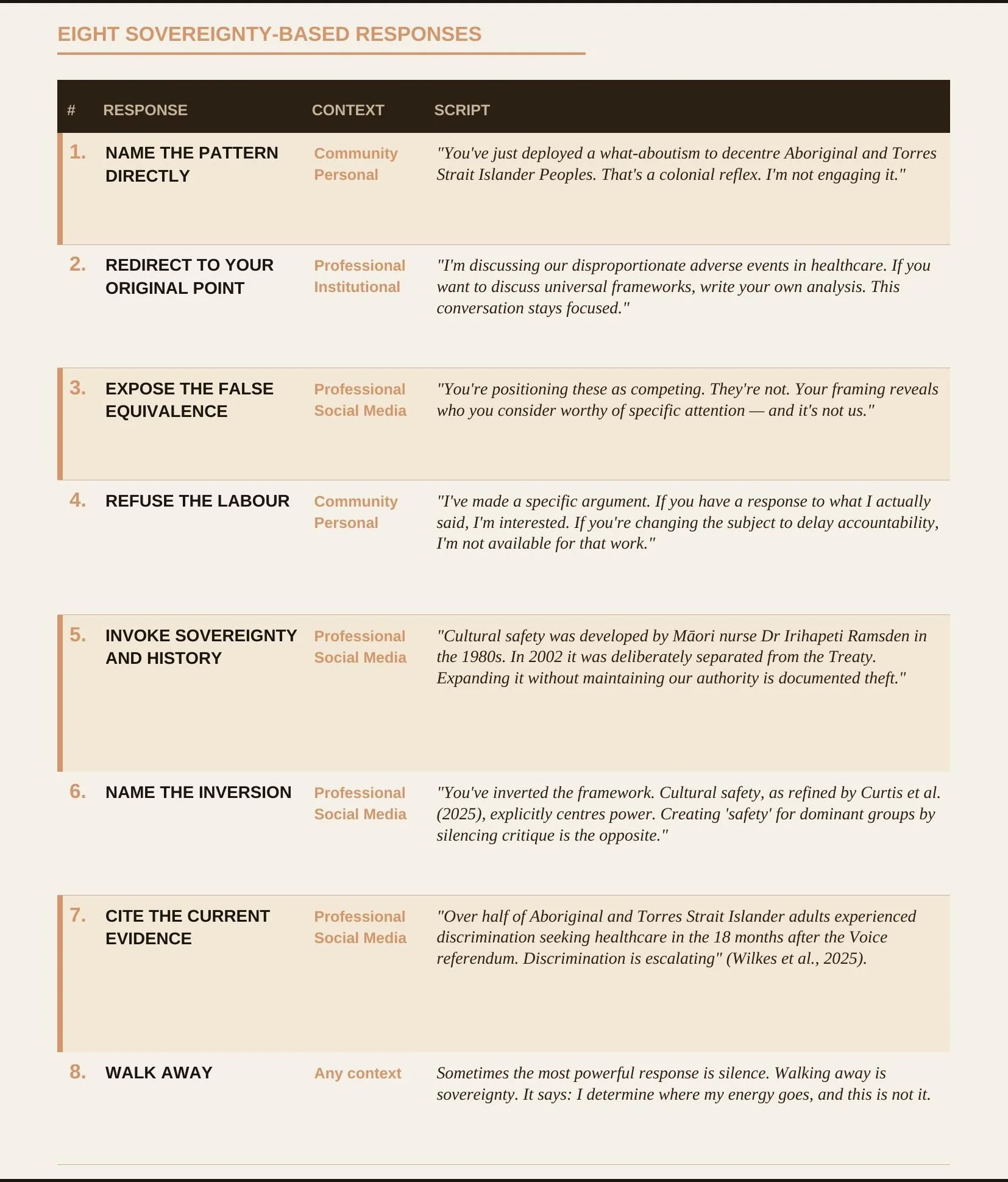
You are not obligated to engage every deflection. Your energy has value. Protect it. But when you choose to respond, here are frameworks grounded in sovereignty.
For Non-Indigenous People Reading This
When you respond to First Nations Peoples' specific analysis with what-aboutism, you are reasserting your authority to determine what gets discussed; protecting institutional comfort at the expense of accountability; positioning your discomfort as more urgent than documented harm; and performing thoughtfulness while preventing change. This is not allyship. This is colonial power protecting itself through your body.
Why You Do It
Scarcity Mindset
The scarcity logic examined earlier is worth naming directly here. You genuinely believe addressing Indigenous-specific harm takes something away from others. This is factually wrong - and it reveals you have never had to operate in systems that were not designed for you. When you have always been centred, specificity reads as exclusion.
White Acceptance As Structural Checkpoint
As Daniels names it: "white acceptance becomes the gateway to recognising and addressing racial harm" (2025, p. 6). When you ask, "What about other communities?" you are not being thorough. You are operating as a checkpoint, requiring First Nations Peoples to obtain your acceptance before their analysis can proceed. That is colonial power with good intentions, which produces the same outcomes as colonial power without them.
"Colour Blind" Institutional Racism
As Elias and Paradies show, "for institutional racism to thrive, people need only be 'colour blind,' 'meritocratic,' ignore the reality of existing privilege and injustices, and simply let the systems and structures reproduce the status quo" (2021, p. 47). Your neutrality is the problem.
White Possessiveness
As Moreton-Robinson (2015) explains, you've internalised proprietary rights over institutions and their frameworks. When First Nations Peoples assert sovereignty claims, it threatens that unconscious assumption.
Automated Colonial Reflex
You're doing what colonial systems trained you to do - diffuse, defer, dilute. This doesn't make you a bad person. It makes you someone operating from unexamined defaults.
What To Do Instead
— Sit with the discomfort of not being centred. When First Nations Peoples centre their own analysis, your job is to listen. Not balance. Not broaden. Listen.
— Recognise that specificity enables coalition. Coalition requires specificity, not false universality.
— Understand the history you’re erasing. De Souza (2026) documents the 2002 broadening as a deliberate deferral of Indigenous sovereignty claims. When you expand frameworks without maintaining our safety as paramount, you’re participating in documented theft.
— Acknowledge racism is escalating - the data is there. This happened while institutions were being “thoughtful” about avoiding the division of communities.
— When you notice the what-aboutism impulse, stop. Ask yourself: "Does this demonstrate engagement with what was actually said, or am I changing the subject?" If it's the latter - don't say it.
Your Authority Is Not In Question
For First Nations Peoples reading this: every time you experience whataboutism deflection, you are experiencing a sovereignty violation. Someone is asserting their authority to determine whether your analysis deserves specific attention.
Your authority is not in question. You do not need their permission to centre your community's safety.
When cultural safety gets co-opted, diluted, or universalised without Indigenous Peoples' authority determining what safety requires, that is theft. When the explicit power analysis gets removed, that is disarming. When it gets inverted so dominant groups claim they need "cultural safety" from your critique, that is gaslighting. When you're told your specific needs must be "balanced" against others, that is colonial logic encoded as equity.
That refusal - refusing to re-legitimise, refusing to justify, refusing to exhaust yourself proving what you already know - is sovereignty in action.
A Final Word to Institutions
The question facing institutions, regulators, and settler communities is not whether they agree with this analysis. They have read it. They have sat in the rooms where these deflections were deployed. They have watched the data accumulate and the frameworks dilute. The question is whether they will become the next exhibit in the next version of this article - or whether they will do the structural work their stated commitments require.
That work has a specific shape. It is not a workshop. It is not a policy commitment. It is the active, enforceable refusal to produce the deflections this article names - in every code review, every standard update, every room where someone asks why we can’t broaden the definition. The deflection has a name now. Using it is a choice.
Reference List
Ahpra. (2019). Ahpra Consultation Report on Cultural Safety Definition [Public Consultation]. Australian Health Practitioner Regulation Agency. https://www.ahpra.gov.au/documents/default.aspx?record=WD20%2f29578&dbid=AP&chksum=WNtpskiQJ01zHJQqObbIow%3d%3d
Australian Health Practitioner Regulation Agency. (2020). National Scheme’s Aboriginal and Torres Strait Islander Health and Cultural Safety Strategy 2020-2025. Australian Health Practitioner Regulation Agency. https://www.ahpra.gov.au/documents/default.aspx?record=WD20%2f29563&dbid=AP&chksum=7v438b3dSNNx%2bd9zleWRbA%3d%3d
Bond, C. J., Whop, L. J., Singh, D., & Kajlich, H. (2020). “Now we say Black Lives Matter but … the fact of the matter is, we just Black matter to them”1. Medical Journal of Australia, 213(6). https://www.mja.com.au/journal/2020/213/6/now-we-say-black-lives-matter-fact-matter-we-just-black-matter-them1
Curtis, E., Loring, B., Jones, R., Tipene-Leach, D., Walker, C., Paine, S.-J., & Reid, P. (2025). Refining the definitions of cultural safety, cultural competency and Indigenous health: Lessons from Aotearoa New Zealand. International Journal for Equity in Health, 24(1), 130. https://doi.org/10.1186/s12939-025-02478-3
Daniels, S. (2025). A Structural Companion Guide: For 30 Patterns of Harm: A Structural Review of Systemic Racism within the London Metropolitan Police Service. London Metropolitan Police Service. https://www.met.police.uk/SysSiteAssets/media/downloads/force-content/met/about-us/london-race-action-plan/a-structural-companion-guide.pdf
De Souza, R. (2026). On the misuse of Cultural Safety. Overland Literary Journal, 259(Feb/March 2026). https://overland.org.au/2026/02/on-the-misuse-of-cultural-safety/
Doherty, B., Evershed, N., & Shimada, Y. (2025, December 15). Visual explainer: How a night of terror unfolded in Bondi. The Guardian. https://www.theguardian.com/australia-news/2025/dec/15/a-visual-guide-to-the-bondi-beach-terror-attack
Fuller, J., Browning, M., Evans, J., & Balvin, N. (2024). How To Attract, Retain and Grow the Aboriginal and Torres Strait Islander Health Workforce in Australia: A self-determined approach: - ACHSM Asia-Pacific Health Leadership Congress in Brisbane 2024. Asia Pacific Journal of Health Management, 19(3), Article 3. https://doi.org/10.24083/apjhm.v19i3.4163
Moreton-Robinson, A. (2015). The white possessive: Property, power, and Indigenous sovereignty. University of Minnesota Press.
Murray, N. (2026, January 26). The question is no longer why the date should change, it is whether Australia has the courage to begin the next chapter in our nation’s story. National Indigenous Times. https://nit.com.au/26-01-2026/22302/the-question-is-no-longer-why-the-date-should-change-it-is-whether-australia-has-the-courage-to-begin-the-next-chapter-in-our-nations-story
Nursing and Midwifery Board of Australia. (2018, March 1). New codes of conduct take effect for nurses and midwives. https://www.nursingmidwiferyboard.gov.au/News/2018-03-01-new-codes.aspx
Papps, E., & Ramsden, I. (1996). Cultural Safety in Nursing: The New Zealand Experience. International Journal for Quality in Health Care, 8(5), 491–497. JSTOR.
Torre, G. (2026, February 17). Invasion Day bombing suspect named as suppression order deemed “not in the interests of justice.” National Indigenous Times. https://nit.com.au/17-02-2026/22718/invasion-day-bombing-suspect-named-as-suppression-order-deemed-not-in-the-interests-of-justice-alleged-terrorism
Watego, C. (2017, October 16). We just Black matter: Australia’s indifference to Aboriginal lives and land. The Conversation. https://doi.org/10.64628/AA.7js4rxn6t
Wilkes, B., Colonna, E., & McKay, C. (2025). Monitoring Aboriginal and Torres Strait Islander mental health and wellbeing around the Voice to Parliament Referendum. Yardhura Walani, ANU. https://yardhurawalani.com.au/wp-content/uploads/2025/12/Report_Tracking-wellbeing-18-months-post-Referendum.pdf
Wilkes, B., Whop, L., Thurber, K., Colonna, E., & Lovett, R. (2026). Embedding cultural safety to combat racism against Aboriginal and Torres Strait Islander peoples: Advice for healthcare settings. Australian Journal of General Practice, 55, 91–96.
Jayde Fuller is a Gamilaraay woman operating from Quandamooka Country. She is the founder of Indigenous Regulatory Practice and spent seven years in health practitioner regulation, including leading the work that embedded self-determination into the definition of cultural safety used across sixteen health professions in Australia's National Law. This article is an output of that practice.
