
Advisory or Authority: What decides whether Indigenous governance is real
Most health organisations now have an Aboriginal and Torres Strait Islander advisory group. Almost none can name a decision it made that the executive could not have overturned. Five things decide the difference between a governance body and a consultation mechanism.
By Jayde Fuller
If your organisation has an Aboriginal and Torres Strait Islander advisory group — and most health organisations in this country now do — here is a question worth sitting with.
Name one decision that group made in the last twelve months that your executive could not have overturned.
Not a decision the executive happened to agree with. Not a recommendation that was accepted. One decision that stood because no one in the organisation had the authority to reverse it.
I put that question to health regulators a few weeks ago, and I expected an argument. I thought I would be told it was unfair. That it was too narrow. That influence works differently, and this isn't how governance is measured.
That isn't what happened.
What came back was recognition. People who sit on these committees answered. People who helped establish them answered. Nobody defended the structure. One reader pointed out that the same question could be put to government departments, which is true, and worse.
Recognition is a stranger result than disagreement.
When you name something as a failure and the people closest to it decline to defend it, you have not found a failure. You have found a design that everybody recognises and nobody has had a reason to examine.
Kaurna and Narungga man, Curtis Falla put it more precisely than I had: are we sharing governance, or merely sharing participation?
That is the subject of this piece. Not whether Indigenous people are in the room. In most health organisations, we are. Whether being in the room does anything.
I'm going to use health regulation as the worked example — it's the system I know from the inside, and it holds the single strongest case anywhere in the world of an institution doing this properly. But nothing in the argument belongs only to regulators. If you sit on a hospital and health service board, a primary health network, a university faculty, a research institute or a government department, it is the same test.
The thing that isn't broken
There is an assumption buried in how we usually answer that question, and it's worth pulling out and looking at properly.
The assumption is that an advisory group is an incomplete version of governance. That someone set out to share power, got part of the way, and stopped — through timidity, or budget, or not knowing how. On that reading the fix is obvious. Finish the job. Strengthen the terms of reference. Appoint a better chair. Add seats.
I don't think that's what happened.
An advisory body is not a governance structure that fell short. It's a different structure altogether, and it works extremely well. It has spread across health organisations in Australia, Aotearoa and Canada alike for the same reason any efficient design spreads. It delivers.
Look at what it reliably produces.
It produces legitimacy — the ability to say, accurately, that the work was done with Indigenous people.
It produces cultural cover — a named body to point to when a decision is challenged.
It produces expertise, genuinely and cheaply, from people who know things the organisation does not, with no obligation attached to what they say.
And it produces deniability. It went to the committee survives almost any scrutiny, including scrutiny from people who suspect it shouldn't.
Four things an institution needs. Not one of them requiring the executive to give up anything at all. I put it more bluntly in The Blueprint: the power to ignore what you have been told stays entirely intact.
That isn't a failure. It's one of the most efficient arrangements in institutional life. It's why nobody ever had to campaign for advisory groups — they propagated on their own, the way a good design does. And they're stable, because no part of the organisation has any interest in destabilising them.
Which brings me to the part I want to be careful about.
Nobody chose this. The people who sit on these committees are doing exactly what they were asked to do, often at real cost to themselves. The executives who established them mostly meant it. The design does its work without anyone in the chain having decided on the outcome — which is what makes it structural rather than moral, and why arguing about intent gets nowhere.
But it also means the obvious fix isn't one.
A stronger chair, clearer terms of reference, more seats at the table — these improve the quality of the advice. Every one of them is worth doing. Not one of them changes what happens on the day the advice is unwelcome.
That day is the only test that matters. And the structure already knows the answer.
What authority requires
So it's worth being exact about what the alternative is.
Authority is the capacity to produce an outcome that survives the disagreement of the person who would prefer otherwise.
In The Blueprint I called this the first of two thresholds — an actual relinquishment of decision-making authority over the lives, care and futures of Indigenous Peoples. That is the principle. What follows is the plumbing.
Everything short of that is influence. Influence is not nothing — it is often how the best work gets done, and I have relied on it for most of my career. But influence is contingent on the goodwill of the person being influenced, and goodwill is not a governance mechanism. It is a relationship, and relationships change with the people in them.
Which means the whole question resolves on a single day: the day the executive would rather not.
Five things determine what happens on that day. None of them is exotic. Every one of them is a choice an organisation has already made in other parts of its business.
A delegation instrument, not terms of reference. Terms of reference describe what a group discusses. A delegation transfers a function from the person who holds it to the body that will now exercise it. One is a description. The other is a transfer.
Reserved matters. A defined list of decisions the executive cannot make alone, where the body's agreement is a precondition rather than an input.
A statutory footing. Policy can be rewritten by the people it constrains. Regulation cannot.
Control over its own membership. Who appoints, and who can quietly decline to reappoint.
An independent secretariat. Who funds the staff, and who those staff report to.
Set out like that, it reads as a checklist. It isn't one, and the difference is the whole point.
A delegation without control over membership is revocable by attrition. Nobody has to overturn the decision. They decline to reappoint the person who made it, and the next iteration of the body decides differently.
A reserved matter without an independent secretariat is a reserved matter whose agenda, papers, options and framing are written by the executive it exists to constrain. The body still decides. It decides between options somebody else drafted.
A statutory footing without a delegation is standing without function — a body that exists by law and does nothing by right.
And control over membership, without any of the rest, is a self-selecting group with no work to do.
These are not five features to be collected. They are one mechanism with five parts, and the weakest part sets the ceiling for all of them. Which is how an organisation can hold three of the five, in good faith, and still produce precisely the outcomes it would have produced holding none.
There is an objection at this point, and it is usually raised in good faith: the board carries the legal accountability, so the board cannot be bound. It deserves more than a line, and I'll come back to it another time. Briefly — boards are bound constantly. By statute. By accreditation standards. By enterprise agreements. By the terms of their own audit and risk committees. And every board in this country delegates enormous authority to a chief executive while remaining fully accountable for what that executive does. Accountability for an outcome and authority over every decision are not the same thing.
So the more useful question isn't whether this can be built.
It's whether anyone has built it.
The one that exists
This is where the regulatory example earns its place.
Once. As far as I know, once.
In Australia, the Medical Board and the Nursing and Midwifery Board delegated decision-making to Aboriginal and Torres Strait Islander National Special Issues Committees. The Australian Health Practitioner Regulation Agency (Ahpra) describes it on its own website, in a single paragraph:
The Aboriginal and Torres Strait Islander Health Strategy Unit (HSU) "collaborated with the Medical Board of Australia and the Nursing and Midwifery Board of Australia to delegate decision-making to the Aboriginal and Torres Strait Islander National Special Issues Committees, comprised of Indigenous and non-Indigenous members, who make decisions regarding complaint and compliance matters involving Aboriginal and Torres Strait Islander notifiers and practitioners.”
Read that against the five conditions and the first one is unambiguous. This is not a committee that advises on complaint and compliance matters. It is a committee that decides them, on a function transferred from the Boards that previously held it. The word doing the work is delegate, and it is Ahpra's own word, in the present tense, about its own arrangements.
That matters more than it sounds. Of the five conditions, the delegation is the one that requires a board to actually give something up. The other four determine whether the transfer holds — but the transfer has to happen first, and somebody had to put it to two national boards and have them agree to it.
I led the unit that did that work. I'll leave it there, because what interests me now is not the achievement. It's how little of it can be seen.
The other four conditions cannot be verified from outside. Whether the delegation is instrumented or merely described. Whether there are reserved matters. Whether it rests on anything more durable than policy. Who appoints the members, and who can decline to reappoint them. Who funds the secretariat, and who those staff answer to.
None of that is published. I don't say that as a criticism — it isn't published anywhere, for any committee, in any jurisdiction I've looked at. Governance documents its outputs and not its architecture.
But follow it through. For the strongest example of Indigenous regulatory authority I know of anywhere in the world, a person standing outside the organisation can confirm exactly one of the five things that would tell them whether it is real.
Which means no amount of published commitment will ever answer the question. Not a strategy, not a statement, not an annual report. If the architecture isn't visible, the only way to know what a governance body can actually do is to look at how it was built.
There is one place that took a different route entirely.
British Columbia
In 2011, Canada, British Columbia and the First Nations Health Society signed the Tripartite Framework Agreement on First Nations Health Governance. Under it, a newly created First Nations Health Authority assumed responsibility for the planning, design, management and delivery of the health programs Health Canada had been running for First Nations in that province. In April 2023 the funding agreement behind it was renewed for another decade, at $8.2 billion.
That is not representation inside somebody else's function. It is the function.
Read the agreement and what strikes you is what happened to the Crown's role. Canada did not stop being responsible for First Nations health. It stopped being the designer and deliverer of it. It became a funder and a governance partner — a government that continues to carry the obligation while deferring to First Nations governance on the decisions.
Defer is the word, and it is the whole argument.
Which makes the objection I set aside earlier harder to sustain. If a national government can transfer decision-making authority while continuing to carry accountability for the outcome, a board cannot really claim its own liability makes the same thing impossible.
That renewal is also the answer to anyone who thinks arrangements like this are fragile. The structure has now survived a full ten years and a renegotiation at scale — which is the only real test of whether something was built or merely announced.
And here is what matters for everything I have said so far.
The framework agreement is fifty-seven pages, and you can download it.
Which means an outsider — a community member, a researcher, a journalist, another organisation — can read what was transferred, who holds it, how it is funded, and what each party owes the others. Several of the five conditions are answerable from the public record, because somebody wrote them down and published them.
Set that beside the paragraph I quoted earlier. And remember which of the two is the global high-water mark for regulation.
I want to be careful here, because this comparison can be pushed further than it deserves. The FNHA is a health authority, not a regulator, and its structure does not map cleanly onto what a college or a national board does.
But British Columbia's regulators are not outside this story. On 1 March 2017, the registrars of every college in BC Health Regulators signed a Declaration of Commitment on cultural safety and humility in the regulation of health professionals serving First Nations and Aboriginal people, in partnership with the FNHA. The province has since gone further than any Australian jurisdiction on the legislative side — Canada's adoption of UNDRIP in 2016, then British Columbia's own Declaration on the Rights of Indigenous Peoples Act in 2019, the Health Professions and Occupations Act in 2022, and the Anti-Racism Act in 2024, each of which speaks to Indigenous-specific racism.
So the ground could hardly be better prepared. And still, nine years after that declaration was signed, the decision-making structures sit with the health authorities rather than with the regulators.
The distinction underneath is the transferable one, and it isn't a matter of degree.
Australia's committees hold authority that was lent to them. Real authority, over real decisions — and held, as all delegated authority is, at the pleasure of the body that delegated it.
British Columbia's is held.
But I don't want to leave this as a story about Australia being behind, because it isn't one. In the jurisdiction that went furthest in the world — with the treaties, the legislation, the declaration and the partnership all in place — the health authorities moved and the regulators have not yet.
Not yet is the part I'd hold onto. Being last is a position, not a nature — and it comes with an advantage. The difficult work has already been done next door. British Columbia's five regional health authorities worked out which decisions would move, on what instrument, and with whose agreement. That is the slow, expensive, unglamorous part, and it exists.
So no regulator setting out now is starting from nothing. They are starting from a worked example, in a comparable system, with people who are willing to describe how it was done.
They only have to be willing to ask.
What it costs
I haven't written this to tell anyone what to build. The five mechanisms aren't secret, and every organisation reading this already uses all of them somewhere else in its business.
What's worth naming is the price, because that's the part nobody says out loud.
Every structure that binds takes something specific from an executive. The ability to set the timeline. The ability to choose the framing. The ability to decline without ever having to say so. The ability to be the last word in the room.
Those aren't trivial losses. Pretending they are is why so many of these conversations go nowhere. An organisation unwilling to give them up won't be argued into it — and I would far rather hear that said plainly than hear another commitment.
But the reverse holds too, and it is the whole of what I am saying here.
An organisation that cannot be bound has not shared power. It has shared its time.
So I'll leave you with the question I opened with. Name the decision. If you can, you have built something rare. If you can't, you now know exactly what is missing — and it was never goodwill.
Reference list
Australian Health Practitioner Regulation Agency (Ahpra) n.d., Aboriginal and Torres Strait Islander Health Strategy Unit, Ahpra, viewed 9 September 2026, https://www.ahpra.gov.au/Health-Strategy-Unit.aspx.
BC Health Regulators (BCHR) 2017, Declaration of commitment: cultural safety and humility in the regulation of health professionals serving First Nations and Aboriginal people in British Columbia, BCHR, Vancouver, viewed 9 September 2026, https://bchealthregulators.ca/declaration-of-commitment/.
Canada, Province of British Columbia & First Nations Health Society 2011, British Columbia tripartite framework agreement on First Nations health governance, Government of Canada, Ottawa, viewed 9 September 2026, https://www.sac-isc.gc.ca/eng/1584706392620/1584706415366.
First Nations Health Authority (FNHA) 2017, All regulated health professions commit to a safer health system for First Nations and Aboriginal people, media release, FNHA, Vancouver, March, viewed 9 September 2026, https://www.fnha.ca/about/news-and-events/news/all-regulated-health-professions-commit-to-a-safer-health-system-for-first-nations-and-aboriginal-people.
First Nations Health Council (FNHC) 2023, Canada announces new $8.2 billion funding agreement with FNHA, media release, FNHC, Vancouver, 14 April, viewed 9 September 2026, https://fnhc.ca/news-release-canada-announces-new-8-2-billion-funding-agreement-with-fnha/.
Fuller, J 2026, 'The Blueprint: how health regulatory bodies can move from cultural safety commitment to structural transformation', Croakey Health Media, 12 June, viewed 9 September 2026, https://www.croakey.org/the-blueprint-how-health-regulatory-bodies-can-move-from-cultural-safety-commitment-to-structural-transformation/.
Prime Minister of Canada 2023, Supporting and improving Indigenous-led health care for First Nations in British Columbia, media release, Ottawa, 14 April, viewed 9 September 2026, https://www.pm.gc.ca/en/news/news-releases/2023/04/14/supporting-and-improving-indigenous-led-health-care-first-nations.
Legislation
Anti-Racism Act 2024 (BC).
Declaration on the Rights of Indigenous Peoples Act 2019 (BC).
Health Professions and Occupations Act 2022 (BC).
IRP works with health regulatory bodies on where decision-making authority actually sits, and what it would take to move it. If the question this article opens with is one your organisation can't answer cleanly, that's where a ‘Threshold Assessment’ starts. Email me at jayde@indigenousregulatorypractice.com.au
The Shelf: How Institutions Delay Without Refusing
No one rejects it. No one argues with it. It simply stops appearing on anyone’s agenda. A systems analysis of how institutions shelve Indigenous-led work without ever saying no.
By Jayde Fuller
There is a particular kind of grief that never makes it into the strategy document. It isn't the grief of being told no. It's the grief of never being told anything at all.
You've seen it. You've maybe lived it. An Indigenous-led solution — designed by community, grounded in what actually works, built to change a system that has failed our people for generations — is welcomed. Praised, even. Minuted. Committed to. Resourced. And then it goes quiet. No one rejects it. No one argues with it. It simply stops appearing on anyone's agenda, and the people who built it are left holding something that was purchased but never used.
I want to give that experience language — not as a list of bad behaviours by bad actors, but as what it actually is: a system doing exactly what it was built to do.
Picture multiple separate pieces of Indigenous-led work, commissioned by the same institution, each fully resourced and delivered. Each one revolutionary in its own field — designed to change how the system treats our people. None of them rejected. None of them implemented. Just quietly, permanently, on the shelf. If that scene is instantly familiar to you, you already know everything this piece is trying to explain. What follows is language for the part you've already lived.
Part One: The System
It isn't individual failure - it's design
Oglala Lakota systems analyst Jesse Grey Eagle [1] argues that systemic outcomes are shaped by lineage, inherited demographics, and exclusionary design — not by the effort or intentions of the individuals inside the system. This matters enormously for how we read the shelf. The report that never gets implemented isn't sitting there because a particular manager was lazy, or a particular committee was slow. It's sitting there because the system was built, through inheritance and design, to produce exactly that outcome.
Grey Eagle's concept of coherence as operating condition is the sharpest tool available here. Western institutional systems are built to optimise their parts — a program, a report, a compliance metric, a reputational milestone. Indigenous systems are built to maintain relational integrity across the whole. When an institution commissions transformative Indigenous work and then shelves it, the institution has not failed at coherence. It has succeeded at a narrower, self-referential coherence — protecting its own legitimacy, its own metrics, its own continuity — directly at the expense of the wider system's coherence: the actual wellbeing of the people the work was meant to serve.
This is why naming individual behaviours, on its own, will always feel unsatisfying. You can document every stalling tactic in a single unit and still not explain why the exact same pattern shows up, independently, across regulators, health services, and government departments who have never spoken to each other. That repetition is the signature of a system, not a coincidence of personalities.
The gap, and the two thresholds
In my own framework [2], the space between commitment and structural transformation has two threshold conditions, which must happen in this order: first, rescinding white and institutional power — an actual relinquishment of decision-making authority over the lives, care and futures of Indigenous Peoples, not a consultation or a seat at a table the institution still controls. Second, actively supporting Indigenous self-determination, leadership, knowledges and governance — not advising on outcomes, but ceding the authority to determine them.
Everything I've described so far — the commissioning, the resourcing, the praise, the minuted commitment — sits in the gap before either threshold is crossed. This is the trap in how the pattern gets misread from inside an institution. Visible activity gets mistaken for movement toward threshold one, when in systems terms it's usually a parameter-level intervention, engineered precisely to generate the appearance of progress without ever touching the rule that actually governs where power sits.
Read through a systems lens, the gap and the two thresholds function as competing operating states inside the same institution. The system's stated goal is to reach both thresholds. Its operating goal — the one revealed by what it actually protects — is to remain, indefinitely, in the gap: visibly active, citable as evidence of commitment, and never structurally required to relinquish anything.
Yellowknives Dene political theorist Glen Coulthard [3] names this same gap at the level of the state. In Red Skin, White Masks, he argues that the politics of recognition does not dismantle colonial power — it reproduces it, by offering Indigenous Peoples narrow concessions of acknowledgement in place of an actual redistribution of land and authority. Recognition, in Coulthard's account, isn't a version of threshold one — it's what a system offers instead of crossing it, fluently enough that the gap can be sustained indefinitely without ever being named as a refusal. What I'm describing at the scale of a single commissioned report, Coulthard is describing at the scale of the settler state. Same gap, different altitude.
Stated goals versus operating goals
Donella Meadows [4], whose systems thinking translates cleanly for institutional audiences, makes a claim that reframes this whole pattern: a system's real purpose is revealed by what it does, not by what it says. Not the mission statement. The behaviour.
Applied here: an institution's stated goal is cultural safety. Its operating goal — the one you can actually read off what gets resourced, protected, and allowed to proceed — is the preservation of institutional control and legitimacy. This is not hypocrisy in the moral sense. It is a system accurately, efficiently pursuing its real goal, while the stated goal performs a separate function, covering the system's exterior so it continues to look aligned with the values it has publicly claimed.
This is the same logic that hollows out a Reconciliation Action Plan (I agree with Prof Marcia Langton and other leaders who declared ‘reconciliation is dead’ after the 2023 referendum). A public commitment costs the system nothing to make and nothing to break, because the system was never optimising for the outcome the RAP names. It was optimising for the appearance of alignment — which is a different goal entirely, and one the system meets in full every time it publishes the document.
Sara Ahmed [5] has a precise term for this: non-performativity. She argues that institutional speech acts declaring a commitment to racial equality don't bring about the effects they name — the statement itself becomes the achievement, standing in for the change it claims to describe. A cultural safety strategy, a RAP, a public commitment to an Indigenous-led solution: each is a speech act doing exactly the work Ahmed identifies. It doesn't fail to produce change. It was never built to. Producing the document is what it was built to do.
Delay, and where institutions choose to act
Meadows treats delay inside a feedback loop as one of the most common reasons systems fail to self-correct — a system that takes too long to respond to information about its own impact simply doesn't respond to it, and the loop breaks not through refusal but through elapsed time. Delay is not neutral: whoever controls its length controls whether the system is ever forced to answer for what it's been told. This is the systems-level description of the thing I most want named: no one ever has to say no. A refusal is a decision, and decisions are attributable. A delay is just time passing, and time passing has no author.
Meadows also ranks intervention points by how much power they have to change a system's behaviour. Near the bottom: adjusting a parameter — a new committee, a round of consultation, a revised timeline. Near the top: changing who holds the rules, or changing the system's actual goal. Institutions facing Indigenous-led solutions overwhelmingly intervene at the bottom of that hierarchy — not as failed attempts at the harder change, but as moves precisely engineered to avoid it. Another socialisation round generates visible activity, which serves the operating goal of appearing responsive while never approaching the real leverage point: who holds the power to decide.
Part Two: How This Shows Up
Once you can see the system, the behaviours stop looking like a random assortment of frustrating habits and start looking like a predictable set of low-leverage interventions, all doing the same job — protecting the operating goal from ever meeting the stated one.
Endless "socialisation." The work keeps being shown to more internal stakeholders, and it forever needs "further consultation" before it can move. Consultation becomes the destination, not a step toward one.
The governance loop. It needs to go to the committee, then the next committee, then be "aligned" with a strategy that hasn't been finalised yet. Each loop is individually reasonable. Together, they're infinite.
Quiet reprioritisation. Nothing is cancelled. It just stops appearing on anyone's agenda. No decision was made — which means no one is accountable for the fact that it died.
The compliment that closes the file. The work gets called groundbreaking, important, exactly what's needed — and the praise itself starts functioning as the response. There's nothing left to actually resource.
Waiting for the right sponsor. The work is ready but needs an executive champion who never quite materialises, so it sits fully formed while no one spends the capital to move it.
Every one of these is a parameter-level intervention in Meadows' sense. None of them touch the rule that actually governs the outcome: who has the authority to decide this moves forward, and whether the institution's real goal permits that decision to be made.
The purchase, and what it costs
I think of the moment of commissioning as the point where extraction and commitment become almost indistinguishable. The institution acquires the labour, the intellectual work, the community-designed solution — and retains complete discretion over whether any of it is ever implemented. The power asymmetry doesn't end at the contract. It's built into everything that happens after delivery, and the person who built the solution has no say in it.
I write this as someone now on the other side of that transaction. I, like many of you, have lived experience of what it costs to hold this pattern from inside institutions. I now offer the same kind of solutions as a consultant, to the same kind of institutions — and I feel the stakes of this differently now, because the labour on the shelf could be mine.
This is what makes the delay a slow torture rather than a single wound. There is no moment of rejection to grieve and move past. There is only the ongoing, accumulating experience of watching something built with care, built to work, sit unused — while the system it was meant to change continues exactly as it was designed to.
Chelsea Watego [6] names this directly. In Another Day in the Colony, she refuses to treat bureaucracy and the academic report as neutral instruments — she names the violence that bureaucratic process and the endless production of reports enacts on Indigenous Peoples, precisely because the report and the process are so often mistaken for progress itself. The shelf isn't a passive storage space where good work waits politely for its turn. It's an active site where harm continues to be done, under the cover of process that looks, to everyone outside it, like nothing is happening at all.
Naming it as resistance
Delay is not a process failure to be patiently endured. It is how a system defends its actual goal without anyone inside it having to admit they're defending it. Solutions designed by community are shelved not because they don't work, but because they work — because implementing them fully would require the system to act against its own operating goal of retained control.
This is not a story about slow bureaucracy. It's a system, functioning exactly as designed, wearing the mask of process.
Responding at the level that matters
If low-leverage interventions are how institutions protect the delay, then the response worth prioritising is whatever moves the conversation toward the leverage points institutions are structurally avoiding: who holds the decision, and what the system's real goal is being asked to do.
Name the mechanism in real time, precisely, not accusingly. "This sounds like it needs further socialisation before we can move" can be answered with: what decision, by whom, by when, would count as moving it forward? Loops survive without anyone asking for one.
Require a decision-owner, not a process. "This needs to align with the strategy" is answerable with: who owns that alignment, and when will it happen? A named person with a date turns a parameter-level delay into an accountable, higher-leverage line item.
Contract for outcomes, not delivery. A completed report is not the deliverable — implementation milestones are. This is the single highest-leverage move available at the point of commissioning, because it changes the rule the system is operating under before the work is ever handed over.
Document the pattern as it happens. Not for confrontation — for evidence. When an institution says "we've always been committed to this," a dated record of loops and reprioritisations turns a feeling into a fact, and makes the delay's authorship visible.
Know your walk-away point, in advance. Institutions rely on Indigenous experts staying in the relationship indefinitely, hoping the next meeting is the one that moves it. Naming what "this isn't going to happen" looks like, before you're inside the fog, protects you from the delay becoming permanent.
Name it collectively, not just privately. A pattern one person names can be dismissed as one relationship gone wrong. A pattern multiple practitioners independently recognise, across institutions that have never spoken to each other, is proof the pattern is systemic rather than personal — which is itself a higher-leverage form of naming than any single account can achieve alone.
If you have felt this — watched something you built sit on a shelf while the system it was meant to fix carried on unchanged — I want you to know it wasn't a failure of the work, or of you. It was the system succeeding at exactly what it was built to do. That is worth naming. At the level where it actually operates, and together.
If you recognised your own institution in this
That recognition is the useful part. A Discovery Session is a bounded, paid piece of analysis, that maps where your regulatory architecture keeps commitments sitting in the gap, and what crossing over the two thresholds would actually require.
Suggested citation
Fuller, J. (2026, 30 July). The Shelf: How Institutions Delay Without Refusing. https://doi.org/10.5281/zenodo.21675488
References
Grey Eagle, J. (2024). Indigenous Systems Thinking Vol 1. Indigenous Futures OS.
Fuller, J. (2026, June 8). The Blueprint: How health regulatory bodies can move from cultural safety commitment to structural transformation. Indigenous Regulatory Practice. https://doi.org/10.5281/zenodo.20586944
Coulthard, G. (2014). Red Skin, White Masks: Rejecting the Colonial Politics of Recognition. University of Minnesota Press.
Meadows, D. H. (2008). Thinking in Systems: A Primer (D. Wright, Ed.). Chelsea Green Publishing.
Ahmed, S. (2012). On Being Included: Racism and Diversity in Institutional Life. Duke University Press.
Watego, C. (2021). Another Day in the Colony. University of Queensland Press.
THE BLUEPRINT: How Health Regulatory Bodies Can Move From Cultural Safety Commitment to Structural Transformation
By Jayde Fuller - Indigenous Regulatory Practice
Suggested citation
Fuller, J. (2026, June 8). The Blueprint: How health regulatory bodies can move from cultural safety commitment to structural transformation. Indigenous Regulatory Practice. https://doi.org/10.5281/zenodo.20586944
The Gap Nobody Names
Most health regulatory bodies have committed to cultural safety. Almost none have achieved it. This article is about why - and what crossing that threshold actually requires. Spoiler: it is not more culturally themed morning teas. Nor is it pulling Indigenous practitioners away from caring for our people to brief non-Indigenous staff on days of cultural significance.
Though written for regulators, this applies to any health institution that holds power over Indigenous Peoples.
The gap between commitment and structural transformation has two threshold conditions. They must happen in this order:
rescinding white and institutional power (power over Indigenous Peoples); and
respecting and supporting the self-determination, leadership, knowledges and governance of Indigenous Peoples.
First Nations and Indigenous Peoples know this gap intimately. We feel it in our bodies, minds and spirits. It hits us when non-Indigenous staff, leaders or Board members minimise us. They minimise our ways of being, our ideas and our experiences, or deem them invalid.
This impact shows up as:
racism (the impact on us matters more than your label or your intentions);
reinforcement of white supremacy culture and the colonial project;
mis-deployment of Indigenous staff;
deterioration of our psychosocial wellbeing [1];
disengagement, silencing and self-censorship;
resignation from the workplace;
tokenistic representation mistaken for governance;
erosion of trust with Aboriginal and Torres Strait Islander / First Nations communities.
What Transformation Is Not
Many interventions in health regulation feel like progress. But they do not change the structure that should prioritise cultural safety. On the surface, some look promising to insiders and stakeholders. They read as markers of transformation. Yet they fall short of both threshold conditions above.
Here are some typical examples from health regulation.
Cultural safety training
It seems reasonable to believe that training produces a culturally safe workplace. Educate the practitioners, the non-Indigenous staff and the Board members - and surely behaviour changes? After all, registered practitioners earn the privilege of treating our populations through rigorous education, testing and practice. Right?
Training has its place. At an individual level, it can shift awareness and build a foundation. But we must be honest about who avoids change here. The regulatory body. The institution. The system.
What this belief fails to acknowledge:
Cultural safety is a lifelong commitment, not a competency you pass or fail. A training session is not the finish line. There is no finish line.
Health regulatory bodies exist because practitioners sometimes fail their obligations. So why assume training works differently? Why assume attendance alone guarantees changed behaviour?
Training frames cultural safety as a knowledge deficit. It implies that if non-Indigenous people knew more, they would act differently. This misdiagnoses the problem. Racism in healthcare is not mainly a knowledge gap. It is a power-and-accountability gap. Training addresses the wrong variable.
Training locates the problem in individuals, not the system. That lets the institution off the hook. When someone acts unsafely after training, the story becomes “that individual failed”. It does not become “this system has no structural accountability”. The institution stays blameless.
Centuries of colonisation and white supremacist culture have shaped every institution we work within. The racist beliefs they produced are not undone in one session. Indoctrination built over lifetimes does not unravel in a morning.
Showing up gets treated as enough. Training becomes a compliance box ticked, not a practice changed. Without accountability designed by and answerable to Indigenous Peoples, patients and staff, neither threshold is met.
Training without consequence is optional in practice. Even when attendance is mandated, application is not. Nothing connects what someone learned on Tuesday to how they treat an Aboriginal patient on Wednesday. The transfer gap is structurally guaranteed.
It places the burden of proof on Indigenous Peoples. We are implicitly required to prove that harm occurred. Meanwhile the practitioner’s good intentions and attendance count as mitigating evidence. The accountability architecture is inverted.
Institutional KPIs measure the wrong things - attendance numbers and the sentiment of non-Indigenous participants. “Do you feel more culturally safe?” is not asked of Aboriginal and Torres Strait Islander Peoples. It is asked of the people whose behaviour needs to change.
Indigenous ‘advisory’ committees
I have heard this many times. “We don’t know what we don’t know. Indigenous Peoples just need to tell us what they want.” “But Jayde,” I hear you say, “isn’t that threshold condition two? Respecting Indigenous leadership?” Asking is not the same as ceding. The power to ignore what you have been told stays entirely intact.
I hate to break it to you. If you have not enacted condition one first - rescinding white and institutional power - you are reproducing ‘colonial load’.[2] Weenthunga Health Network defines it as:
the load placed knowingly and unknowingly on First Nations people by settlers and institutions. It includes biases, assumptions, expectations and entitlement held by Settlers. Settlers are often ignorant and in denial of the load’s existence. The load is highly visible to us as First Nations people. When the burden to carry the load is placed on us, it causes harm. It can lead to burnout and impact our ability to maintain our cultural responsibility.
You are essentially telling First Nations Peoples something stark. Their intellectual labour, experiences and knowledge can be extracted at any time. But you are under no obligation to act on it, because the power structure stays unchanged.
So what does the institution do with that expertise? It filters the knowledge through existing power structures. It reinterprets it to fit what it was always going to do. Then it cites it as evidence of Indigenous consultation. The knowledge gets laundered. That is the colonial mechanism operating in plain sight.
Look at the word naming the committee: ‘advisory’. This is not phoning a friend about your Friday-night outfit, advice you can take or leave. The Indigenous people on that committee need real power. They need decision-making and authorising power to effect structural change, independent of the regulatory body’s hierarchy. Without it, you will burn out those staff, Board members and practitioners - or erode their trust fast.
It also carries an unwanted cost to the institution. It signals to Indigenous communities that this body does not listen to or care about our people. Our communities are small and deeply relational. Relationships are the infrastructure through which knowledge, trust and accountability move. This is not incidental to how we operate. It is the governance mechanism itself.
Western institutions tend toward transactional relationships. So they underestimate how fast reputational damage travels through Indigenous networks. They also underestimate how hard it is to repair. That is especially true when it affects our safety, our access to care, or our ability to advocate for our communities.
Indigenous staff in roles without authority
You may have Indigenous Peoples on your payroll, appointed to improve cultural safety and access. But without real authority to enact structural change, this is window dressing. It is a photo opportunity for an employment strategy. And it is deeply disempowering for those staff.
Then there is the role design problem. These positions are often created without a clear mandate. They lack reporting lines that give genuine influence. They lack resourcing matched to the scope of change required. The disempowerment is baked into the job description before the person starts. That is not an individual failure. It is an architectural one.
An anti-racism policy where non-Indigenous HR staff decide complaint outcomes
Picture an anti-racism policy where non-Indigenous HR staff control the process and outcome of harm declared by Indigenous Peoples. That is not accountability. It is the institution investigating itself. The power to define racism, and to decide a proportionate remedy, stays with the people least positioned to judge it.
The Two Thresholds
A threshold is not a milestone. Milestones can be reported against, celebrated and filed away. A threshold is a structural shift. It is the moment the architecture of power changes irreversibly. The next board cannot undo it. Neither can the next budget cycle, nor the next executive who downgrades cultural safety.
There are two thresholds. They must happen in order.
Threshold One: The Rescinding of White and Institutional Power
This is the one nobody wants to name directly. It requires the institution to make a genuine transfer. Not a consultation. Not a partnership. Not a seat at a table it still controls. It means an actual relinquishment of decision-making authority over the lives, care and futures of Indigenous Peoples.
We have seen it happen. In 2013, the First Nations Health Authority (FNHA) became the first province-wide First Nations health authority in Canada.[3] Health Canada did not partner with FNHA. It ceded jurisdictional authority to it. The federal government transferred responsibility for the design, delivery and governance of health services to an Indigenous-led body. That body is accountable to First Nations Peoples and governed by First Nations Peoples, on First Nations terms. That is Threshold One in practice. It is not symbolic. It is architectural.
Most health regulatory bodies have not come close.
Threshold Two: Respecting and Supporting Self-Determination, Leadership, Knowledges and Governance
The second threshold is not softer than the first. But it is more specific. It requires the institution to actively support Indigenous Peoples’ authority to determine outcomes that affect them. Not to consult. Not to advise. To determine.
British Columbia is instructive here too, and not by accident. The province has built a layered architecture. The sequence in which it was built is precisely what gives it force.
Indigenous governance authority was established at the apex through FNHA. So the practitioner and organisational layers that followed had something real to answer to. In 2022, the British Columbia College of Nurses and Midwives (BCCNM) brought a new practice standard into force.[4] It made cultural safety a regulatory obligation for every nurse and midwife in the province. Not an aspiration. A condition of practice. Developed with Indigenous authority behind it, the standard creates enforceable individual accountability.
Alongside this, the Health Standards Organization developed a standalone BC Cultural Safety and Humility Standard.[5] Its structure matters as much as its content. It is not absorbed into patient safety frameworks. It is not embedded as a sub-criterion of quality care. That absorption is how cultural safety is quietly diluted elsewhere. This standard exists independently. Organisations cannot cross-reference their way out of it. They must demonstrate it on its own terms.
The result is three distinct layers of accountability working in concert. Indigenous governance authority sits at the apex, in FNHA. Practitioner-level accountability runs through the BCCNM standard. Organisational accountability runs through a standalone accreditation standard that other criteria cannot satisfy. No single layer can be gamed in isolation. An organisation cannot demonstrate cultural safety at accreditation while its practitioners stay unaccountable to the practice standard. And both layers sit where Indigenous governance authority exists and holds real power.
Critically, the standards came after the governance architecture, not before it. That sequencing is not incidental. The BCCNM and HSO standards have teeth because the FNHA exists to give them teeth. Where standards are built without that governance foundation, they tend to become documents. Organisations perform compliance with them rather than transform toward real accountability.
In Australia, the framework governing health practitioner regulation has changed by law. The Aboriginal and Torres Strait Islander National Special Issues Committees now help determine the outcome of culturally unsafe care.[6] This represents meaningful movement toward Threshold Two. Indigenous Peoples are not being asked to advise on what should happen to a practitioner who caused harm. They are making that determination. That is structurally different.
It is worth being honest about what this example also shows. Accountability mechanisms can move toward Threshold Two before Threshold One is enacted. Has institutional power genuinely been rescinded? Or can the institution still wind these mechanisms back? That is a different and still-open question.
Most regulatory bodies have enacted neither threshold. Many are nowhere near Threshold One. In most cases, the gap between what is achieved and what strategy documents claim is significant. That gap is not accidental. It is structurally produced - by the same architectures that cultural safety transformation is meant to dismantle.
Where does your organisation actually sit?
This is the framework, not the diagnosis. If you want the short version — a one-page way to test where your own organisation actually sits — I send that to my list before it goes anywhere public.
What It Actually Feels Like
Are you a non-Indigenous executive, leader or board member? Then I want to be honest about what this work will ask of you. Not to frighten you. I want to stop you misreading what comes next as failure. It is, in fact, evidence that something real is happening.
You will need epistemic humility. That is not a soft ask. It means genuinely recognising that your ways of knowing, doing and being are not the only ones that exist. The frameworks through which you understand governance, accountability, evidence and leadership are one set. Not the set. One.
Indigenous knowledges have sustained peoples and communities for more than sixty thousand years. They are not primitive, not pre-scientific, not in need of translation into Western frameworks to become valid. They are complex, relational and deeply nuanced. And they do not operate through the zero-sum logic that whiteness typically defaults to.
Zero-sum logic holds that for one group to gain, another must lose. It is a scarcity framework. It treats power, authority and legitimacy as finite resources to compete over, not capacities that can be structured differently. Ibram X. Kendi traces how this logic underpins some of today’s most dangerous ideologies.[7] These include Great Replacement Theory - the belief that one group’s advancement is an existential threat to another. The same logic operates, often unnamed, in institutional resistance to Indigenous governance. The assumption is that if Indigenous peoples gain authority, white institutions must be losing something. That if Indigenous knowledges are validated, Western frameworks are diminished. That power shared is power lost.
This is a false frame. But it is a persistent one. It is embedded in the epistemological architecture of the very institutions we are asking to change.
Indigenous relational epistemologies do not begin from scarcity. Right or wrong, compliant or non-compliant, inside or outside the standard - these categories are not universal. They are design features of systems built to serve white institutional interests. And they consistently fail to account for the sophistication of Indigenous governance, knowledge and community. When you feel the pull to resist relinquishing power, ask which framework is generating that feeling. The zero-sum lens is not revealing a truth about power. It is obscuring one.
Here is the harder thing. Systems and institutions are built around white comfort. That is not an accusation. It is a structural diagnosis. So genuinely supporting cultural safety for Aboriginal and Torres Strait Islander / First Nations Peoples will require something of you. You will need to become uncomfortable. And stay there.
That discomfort has two faces. The first is internal. It is recognising where your instincts come from. Your default judgements and your sense of what is normal were shaped by institutions not designed with Indigenous peoples in mind. That is uncomfortable to sit with.
The second is interpersonal. Structural change requires you to challenge institutional norms in the room. Those norms are held by your peers - people who share your professional culture, your career context and often your race. That carries social and professional cost. It will not always be received well.
I am not telling you this so you retreat from it. I am telling you for a reason. If you wait for this work to feel comfortable before you commit, you will wait indefinitely. The discomfort is not the obstacle. The discomfort is the mechanism.
What Indigenous Leadership Actually Means
Not consultation. Not a seat at the table. Decision-making authority. Governance with real teeth.
Indigenous leadership is not a seat at the table. By now, I hope that is clear. Let me be precise about what it is.
Indigenous governance - the real kind - means decision-making authority. Not advisory authority. Not the authority to recommend, submit or be consulted. The authority to decide. That authority must come with the resources to act on decisions. On our terms - not contingent on institutional approval of how we use them.
It means leadership without conditions. Non-Indigenous institutions habitually support Indigenous leadership in principle while attaching conditions in practice. Conditions about process. About format. About which governance structures count as legitimate. Those conditions are how institutional power reasserts itself over Indigenous authority. Genuine support means withdrawing them.
It means accountability to community. Often Indigenous leaders and governance bodies are accountable mainly to the institution that funds or hosts them. That structure reproduces the colonial relationship. It positions the institution as the authority Indigenous leaders must answer to. Genuine Indigenous governance inverts that. Accountability runs to community. It runs to the Indigenous peoples whose health, safety and lives are at stake. If our practice or decisions are challenged, that challenge should come from the people we serve. Not from white institutions.
This is not a theoretical position. It is a practical one. Institutions that genuinely supported Indigenous governance have had to make real changes. They changed how they structure authority, how they resource it and how they understand their own role. They have had to move from centre to periphery. That shift is what Threshold One requires. Indigenous leadership is what becomes possible on the other side of it.
The Question for Every Health Regulatory Body
Every health regulatory body I have met can say yes to one question: “Are you committed to cultural safety?” The commitment is rarely the problem. Commitments are made at board level, written into strategic plans, announced at events and cited in annual reports.
The question that determines whether transformation is possible is different. It is not about commitment. It is about relinquishment. What are the institution, and the people who hold power within it, genuinely willing to give up? Decision-making authority. The comfort of familiar processes. The safety of institutional consensus. The assumption that Western frameworks are the right lens for evaluating Indigenous leadership.
What are you willing to relinquish?
Has that question landed somewhere real? Has it named something about where your organisation is, or where it is stuck? Then I would welcome a conversation.
Threshold Assessments with Indigenous Regulatory Practice begin here. To book one, email me at jayde@indigenousregulatorypractice.com.au
Not ready for a conversation yet? [Join the list] — one piece like this, roughly monthly.
References
Wilkes B, et al. - Embedding cultural safety to combat racism against Aboriginal and Torres Strait Islander peoples. Australian Journal of General Practice (RACGP); March 2026. https://www1.racgp.org.au/ajgp/2026/march/embedding-cultural-safety-to-combat-racism-against↩
Weenthunga Health Network - definition of 'colonial load'. https://weenthunga.com.au/↩
First Nations Health Authority - About the FNHA (Province of British Columbia / FNHA). https://www.fnha.ca/about↩
BC College of Nurses and Midwives - Indigenous Cultural Safety, Cultural Humility and Anti-Racism Practice Standard (effective 25 February 2022). https://www.bccnm.ca/RN/PracticeStandards/Pages/CulturalSafetyHumility.aspx↩
Health Standards Organization - British Columbia Cultural Safety and Humility Standard (HSO 75000:2022). https://healthstandards.org/standard/cultural-safety-and-humility-standard/↩
Australian Health Practitioner Regulation Agency - Aboriginal and Torres Strait Islander Health and Cultural Safety Strategy: Communiqués. https://www.ahpra.gov.au/About-Ahpra/Aboriginal-and-Torres-Strait-Islander-Health-Strategy/Communiques.aspx↩
Ibram X. Kendi - Chain of Ideas: The Origins of Our Authoritarian Age (2026). https://www.penguinrandomhouse.com/books/778233/chain-of-ideas-by-ibram-x-kendi/↩
"What-Aboutism" as Colonial Technology: A Guide for First Nations Peoples
What-aboutism deflection is not a communication failure. It is colonial technology - an automated institutional defence that activates when First Nations Peoples name specific harm and demand specific accountability. This piece argues that what-aboutism functions as a discursive mechanism with identifiable patterns, a documented history, and measurable consequences: in the 18 months following the Voice to Parliament referendum, over half of Aboriginal and Torres Strait Islander adults experienced discrimination when seeking healthcare. Discrimination is escalating - not improving - precisely as the frameworks designed to address it are being diluted.
By Jayde Fuller
Suggested Citation
Fuller, J. (2026). "What-aboutism" as colonial technology: a practical guide for First Nations People - how deflection operates as an automated defence system and how to respond from sovereignty. Indigenous Regulatory Practice. https://doi.org/10.5281/zenodo.18948592
Abstract
What-aboutism deflection is not a communication failure. It is colonial technology - an automated institutional defence that activates when First Nations Peoples name specific harm and demand specific accountability. This piece argues that what-aboutism functions as a discursive mechanism with identifiable patterns, a documented history, and measurable consequences: in the 18 months following the Voice to Parliament referendum, over half of Aboriginal and Torres Strait Islander adults experienced discrimination when seeking healthcare. Discrimination is escalating - not improving - precisely as the frameworks designed to address it are being diluted.Drawing on Daniels’ structural harm frameworks, the documented co-optation of Dr Irihapeti Ramsden’s cultural safety into a universal one, and current Mayi Kuwayu data, this piece maps five patterns of what-aboutism, traces their institutional logic, and provides eight sovereignty-based responses for First Nations Peoples who choose to engage them. It closes with a direct address to the institutions and individuals producing the deflections it names.On January 26th, a white supremacist threw an explosive device into a crowd of Aboriginal and Torres Strait Islander Peoples in Perth, marching to change the date of Australia Day – “the anniversary of invasion, dispossession, and the beginning of policies that sought to erase us (Murray, 2026).”
A week and a half passed before authorities called it terrorism. The perpetrator remained unnamed "for his safety” - what Mununjahli and South Sea Islander Prof Chelsea Watego (2017) identified eight years earlier as “the privilege of white murderers of Black children: protection through anonymity while victims remain unknown.” Only after sustained pressure from Indigenous communities was the terrorist identified as Liam Alexander Hall (Torre, 2026).
The Bondi terrorists (Doherty et al., 2025) - brown men - were named within hours.
The responses that followed were predictable and cutting:
— "What about other communities?"
— "The bomb should have gone off."
— "He's a one off - he's been radicalised."
— "Who cares?"
Race determined who got called a terrorist immediately and who didn't. Race determined who received institutional protection and who was exposed. Race determined whose lives were grievable.
If you are an Indigenous person and you have ever raised specific harm against your communities only to have someone immediately redirect to other issues, other groups, other concerns - you know this pattern.
It has a name: "what-aboutism" deflection, or as I colloquially call it, the Shannon Noll effect (for non-Australians, this references a singer who famously covered the ‘Moving Pictures’ song "What About Me?"). And it's not random. It's colonial technology operating with precision to prevent the specific accountability you are demanding.
This guide gives you the tools to recognise it, understand what is actually happening, and respond from a place of sovereignty.
Defining What-Aboutism Deflection
DEFINITION
What-aboutism deflection is a discursive weapon that derails specific accountability by redirecting attention elsewhere. It operates as colonial technology: an automated defence system that activates when First Nations Peoples name specific harms and demand specific solutions.
How It Operates
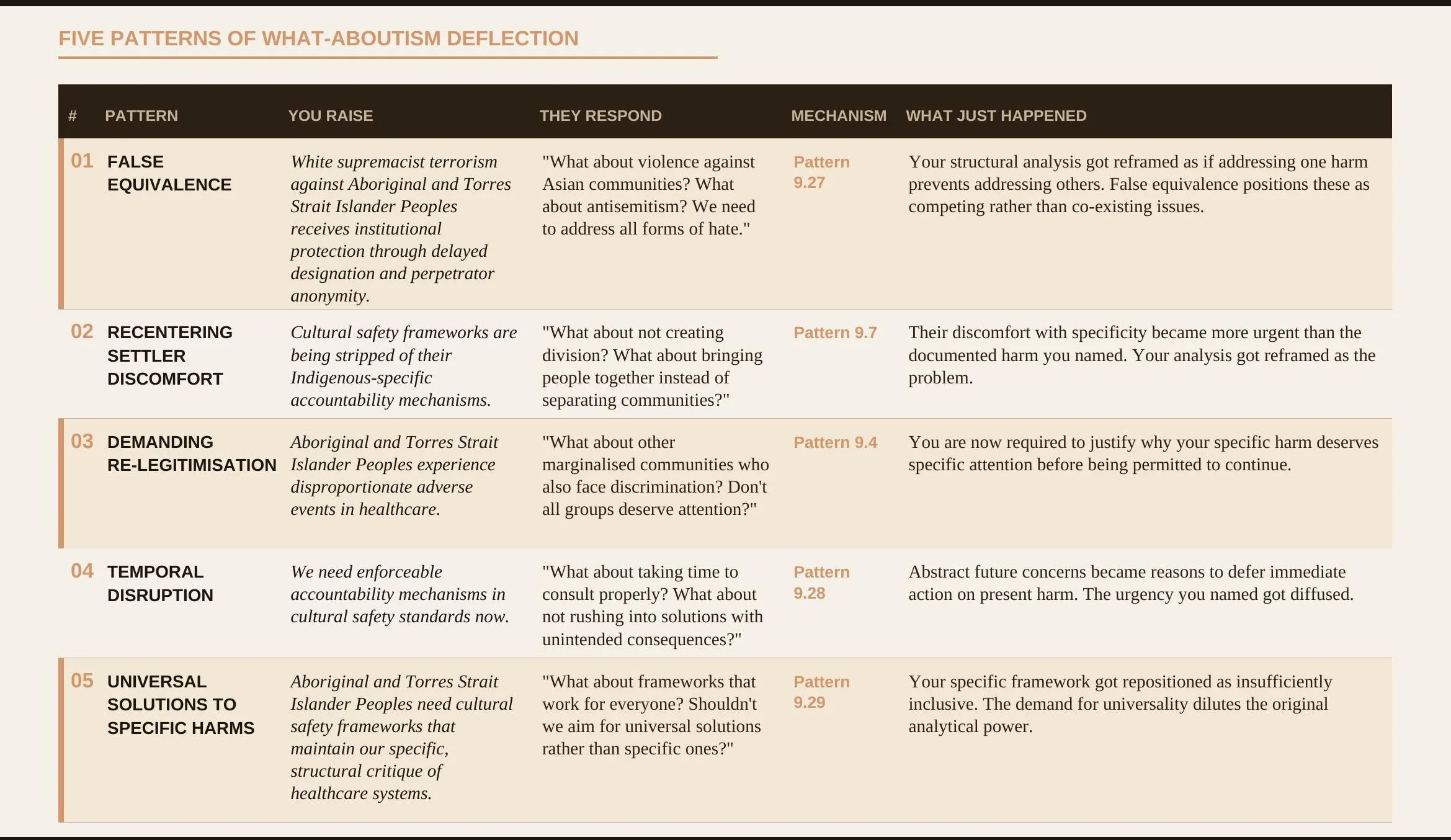
—False equivalence - positioning unrelated harms as competing priorities
— Recentering settler discomfort - making institutional unease more urgent than documented harm
—Demanding re-legitimisation - requiring Indigenous peoples to prove why Indigenous-specific solutions aren't exclusionary
— Temporal disruption - deferring action through concerns about process
— Universal dilution - insisting Indigenous frameworks must apply "to everyone" or they're unfair
What It Achieves
DEPLETION OF ORGANISING CAPACITY
Energy spent re-explaining is energy not spent organising for change.
DEFERRAL
Accountability is perpetually delayed pending "broader consultation."
DILUTION
Indigenous frameworks lose their sovereignty-based power analysis and are repositioned as one consideration among many.
MANUFACTURED ACTIVITY WITHOUT ACCOUNTABILITY
What-aboutism doesn't just exhaust and defer - it generates the appearance of institutional rigour. As Daniels (2025) observes, "recommendations have become a routine way for the [institution] to perform change without undergoing it" (p. 8). What-aboutism is how colonial institutions stay busy without ever having to change.
WHAT IT IS NOT
Genuine questions about implementation, coalition-building dialogue, or good-faith engagement with complexity. The distinction lies in intent and effect: genuine engagement seeks to understand Indigenous frameworks and build upon their structural rigour; what-aboutism deflection seeks to diffuse specificity, defer accountability, and protect white possessive investments in institutions.
This pattern is not random. This is not individuals being thoughtless. This is colonial technology functioning exactly as designed.
This pattern is not random. This is not individuals being thoughtless. This is colonial technology functioning exactly as designed.
How to Recognise What-Aboutism Deflection
Five predominant patterns, each mapped to the institutional mechanisms identified by Dr Shereen Daniels in 30 Patterns of Harm A Structural Review of Systemic Racism within the London Metropolitan Police Service (2025).
What's Actually Happening: The Theory
Scarcity Mindset
Safety is not scarce. Addressing Aboriginal and Torres Strait Islander Peoples’ disproportionate harm in healthcare does not prevent addressing other communities’ needs - it establishes the structural rigour required for everyone.
“For institutional racism to thrive, people need only be "colour blind," "meritocratic," ignore the reality of existing privilege and injustices, and simply let the systems and structures reproduce the status quo.”
- Elias & Paradies (2021, p. 47)
Daniels (2022) names the absurdity of this logic from her own experience of cancer treatment: no other consultant barged into her specialist’s office demanding he turn his attention elsewhere, no nurse complained her tests caused a backlog, and no cardiologist asked “What about my patients?” As she concludes: “Racism needs specific intervention. Taking a generalised approach to specific problems never yields impressive results” (pp. 156-157). The scarcity framing isn’t a reasonable concern about resource allocation. It is a mechanism for protecting institutional comfort at the expense of accountability.
Colonial Reflex
What-aboutism is how colonial powers protect themselves when threatened. When First Nations Peoples name specific harm and demand specific accountability, we threaten institutional arrangements that have never had to centre us. The reflex is automated colonial defence: diffuse our specificity, redirect attention away from structural critique, reframe our analysis as the problem, and exhaust us before we can organise for change.
White Possessiveness As A Foundation
Goenpul scholar Distinguished Professor Aileen Moreton-Robinson names the mechanism beneath this reflex: white possessiveness (2015). She argues that white possession operates at both ontological and epistemological levels. At the ontological level, "to be able to assert 'this is mine' requires a subject to internalise the idea that one has proprietary rights that are part of normative behaviour, rules of interaction, and social engagement" (Moreton-Robinson, 2015, p. 50).
“White possession operates discursively through narratives of the home of the brave and the land of the free… Against this stands the Indigenous sense of belonging, home, and place in its sovereign incommensurable difference.” - Moreton-Robinson (2015, p. 52)
The Co-optation of Cultural Safety: A Documented History
Cultural safety was developed by Ngāi Tahu, Rangitāne nurse Dr Irihapeti Ramsden as a structural critique. It centred Indigenous Peoples' authority to determine what constitutes safety in systems designed to harm us. It demanded institutions examine their own power, not just train practitioners in cultural awareness.
“Cultural safety was developed in the 1980s and 1990s as an Indigenous-led anti-colonial critique of nursing's Anglo-European knowledge base. It represented a bicultural, liberatory framework based on Te Tiriti o Waitangi and the notion of negotiated partnership between Māori as Tangata Whenua (people of the land) and settlers.” - Nurse academic, Dr Ruth De Souza (2026)
Australia now faces the same risk Aotearoa experienced in the 1990s and 2000s. There is growing pressure to broaden cultural safety frameworks beyond their Indigenous-specific foundations. While antisemitism is real and requires action, the solution is not appropriating Indigenous frameworks and stripping them of their sovereignty-based power analysis.
The contradiction is stark: the same Australian institutions resisting Aboriginal and Torres Strait Islander sovereignty claims have no difficulty supporting Zionist settler-colonial projects in Palestine. Apparently, Indigenous sovereignty is divisive when it's ours, but worthy of institutional investment when it's Israel's. This selective application reveals that what-aboutism is not about genuine solidarity - it's about protecting white possession by co-opting our frameworks while funding the dispossession of other Indigenous Peoples.
The colony does not abandon a framework it cannot immediately defeat. It waits. It asks reasonable questions. It broadens, dilutes, and repositions - until the framework that was built to hold it accountable becomes a tool it can use to protect itself. That is what De Souza (2026) documents in Aotearoa. That is what I witnessed across years of regulatory work in Australia. And that is what will happen here if we become complacent.
My parents’ and grandparents’ generation were denied access to culturally safe healthcare. They experienced racism seeking care, and they died in preventable ways because no accountability structure compelled anyone to do otherwise. What the National Law now contains - the principle that Aboriginal and Torres Strait Islander Peoples alone determine what is and isn’t culturally safe - is the structural answer to that. It took collective effort, sustained resistance, and years of fighting the same fight over and over to put it there.
Definition of Cultural Safety (National Law, Australia)
Cultural safety is determined by Aboriginal and Torres Strait Islander individuals, families and communities.
Culturally safe practise is the ongoing critical reflection of health practitioner knowledge, skills, attitudes, practising behaviours and power differentials in delivering safe, accessible and responsive healthcare free of racism. (Australian Health Practitioner Regulation Agency, 2020, p. 9)
We cannot rest on that victory. The definition must be actively defended - in every code review, every standard update, every conversation where someone asks why it can’t apply to everyone. Because the answer to that question is not a bureaucratic technicality. It is sovereignty. And sovereignty, in this country, has never been given. It has only ever been held.
The Documented Timeline of How Cultural Safety Was Stolen
1980s
Dr Irihapeti Ramsden (Ngāi Tahu, Rangitāne) develops Kawa Whakaruruhau ("cultural safety") as Māori-specific structural critique grounded in Te Tiriti o Waitangi. Core principles: Māori authority to determine safety; critical self-reflection by practitioners on their own power; structural transformation, not individual competency checklists.
1992
Nursing Council of New Zealand formally adopts Kawa Whakaruruhau into nursing and midwifery education.
1995
Parliamentary Select Committee investigation triggered by dominant group backlash.
1996
First broadening following external review: "The concept of cultural safety was then developed into a separate and broader philosophical perspective to change its primary focus from Māori and Kawa Whakaruruhau to the inclusion of all minority groups."
2002
Guidelines go further, separating cultural safety entirely from Te Tiriti and Māori health - what De Souza calls "a deflection and deferral of Indigenous sovereignty claims… conflating racialisation and colonisation."
2018
Ahpra introduces cultural safety into nursing and midwifery codes of conduct, 39 years after its development in Aotearoa, in a diluted form (Nursing and Midwifery Board of Australia, 2018).
2019
Ahpra releases its definition of cultural safety following a public consultation process (Ahpra, 2019), and was rightfully determined by Aboriginal and Torres Strait Islander health leaders.
2025
Curtis and colleagues publish refined definitions acknowledging the need to explicitly name power as central to cultural safety - what had been implicit in Ramsden's work but lost in translation (Curtis et al., 2025). The Nursing and Midwifery Board of Australia changed its definition to align with the National Scheme’s definition.
What De Souza's analysis reveals is not just that the framework was diluted. A specific, load-bearing element was removed. The 2002 broadening “didn't demolish the building - it left the paintwork standing and took out the steel frame” (Daniels, 2025, p. 12). You can mandate cultural safety training without ever centring Indigenous authority. You can claim progress while the harm escalates. As Daniels puts it: "Change the décor, and nothing shifts. Change the structure, and everything does" (2025, pp. 12-13).
THE POWER THAT WENT MISSING
“Cultural safety needs to explicitly focus on power… cultural safety foregrounds power differentials within society, the requirement for health professionals to reflect on interpersonal power differences, and how the transfer of power within multiple contexts can facilitate appropriate care.” - (Papps & Ramsden, 1996, p. 493)
WHEN DOMINANT GROUPS CLAIM "CULTURAL SAFETY"
De Souza (2026) names what happens when the framework gets inverted: "When a subject from a dominant group claims a need for cultural safety, even on behalf of another, they are also working against the idea that marginalised groups have specific knowledge that allows them to identify what is culturally safe. It is a discourse that erases and appropriates the affective space of marginality."
As De Souza concludes, cultural safety's transformation from a structural intervention to a tool of dominant groups now functions as "a form of gaslighting."
The Evidence: Discrimination Is Escalating, Not Improving
Data from Mayi Kuwayu: The national study of Aboriginal and Torres Strait Islander wellbeing shows that in the 18 months since the Voice to Parliament referendum (October 2023 - April 2025), over half (51.8%) of Aboriginal and Torres Strait Islander adults experienced discrimination when seeking healthcare. Vicarious racism - hearing jokes, insulting comments, or witnessing unfair treatment - is pervasive at 78.8% (Wilkes et al., 2025).
This is not improvement. This is escalation. And it's happening precisely as cultural safety frameworks get diluted into universal approaches that avoid naming racism and avoid the explicit power analysis Ramsden embedded from the beginning.
The data does not capture the full picture. Aboriginal and Torres Strait Islander health professionals experience racism frequently at work, and often face resistance or retribution when they identify injustices (Fuller et al., 2024; Wilkes et al., 2026). This is the structural function what-aboutism serves in practice environments - it does not simply deflect patients’ experiences of racism. It suppresses the capacity of the very practitioners most equipped to name and challenge it. What-aboutism is not just a conversation tactic. It is a workforce mechanism.
Yet data alone does not move institutions. Daniels (2022) is precise about why: "data is also an output. It measures things after the fact. It measures the what, not the why" (p. 180). The Mayi Kuwayu figures tell us what is happening to Aboriginal and Torres Strait Islander Peoples in healthcare. They do not tell us why institutions that have seen this data for years remain unmoved by it. What-aboutism is part of the answer - it provides the mechanism by which institutions acknowledge the what while perpetually deferring the why.
Bond, Whop, Singh and Kajlich (Bond et al., 2020) name this pattern with precision - Bond (writing as Watego) among them. The statistical story of Indigenous health and death has been reported in federal parliament for over a decade - an annual account-keeping exercise of policy failure that never translates to improved outcomes. The contrast they draw is instructive: when COVID-19 threatened, institutional action was swift. The ongoing pandemic of racism that Indigenous Peoples have been fighting since 1788 produced no equivalent mobilisation. This is not institutional incapacity. It is institutional indifference - and indifference is a structural choice, not an oversight.
Why Exhaustion Is the Point
Every what-aboutism requires you to re-explain why your specific issue matters; re-establish your legitimacy to centre it; re-justify why addressing it specifically isn't exclusionary; and defend against the implication you don't care about other communities.
That exhaustion is not a side effect. It's the design. Colonial systems have avoided accountability for centuries, not through outright refusal alone, but through infinite deferral - always another perspective to balance, another community to consider, another reason now is not the moment.
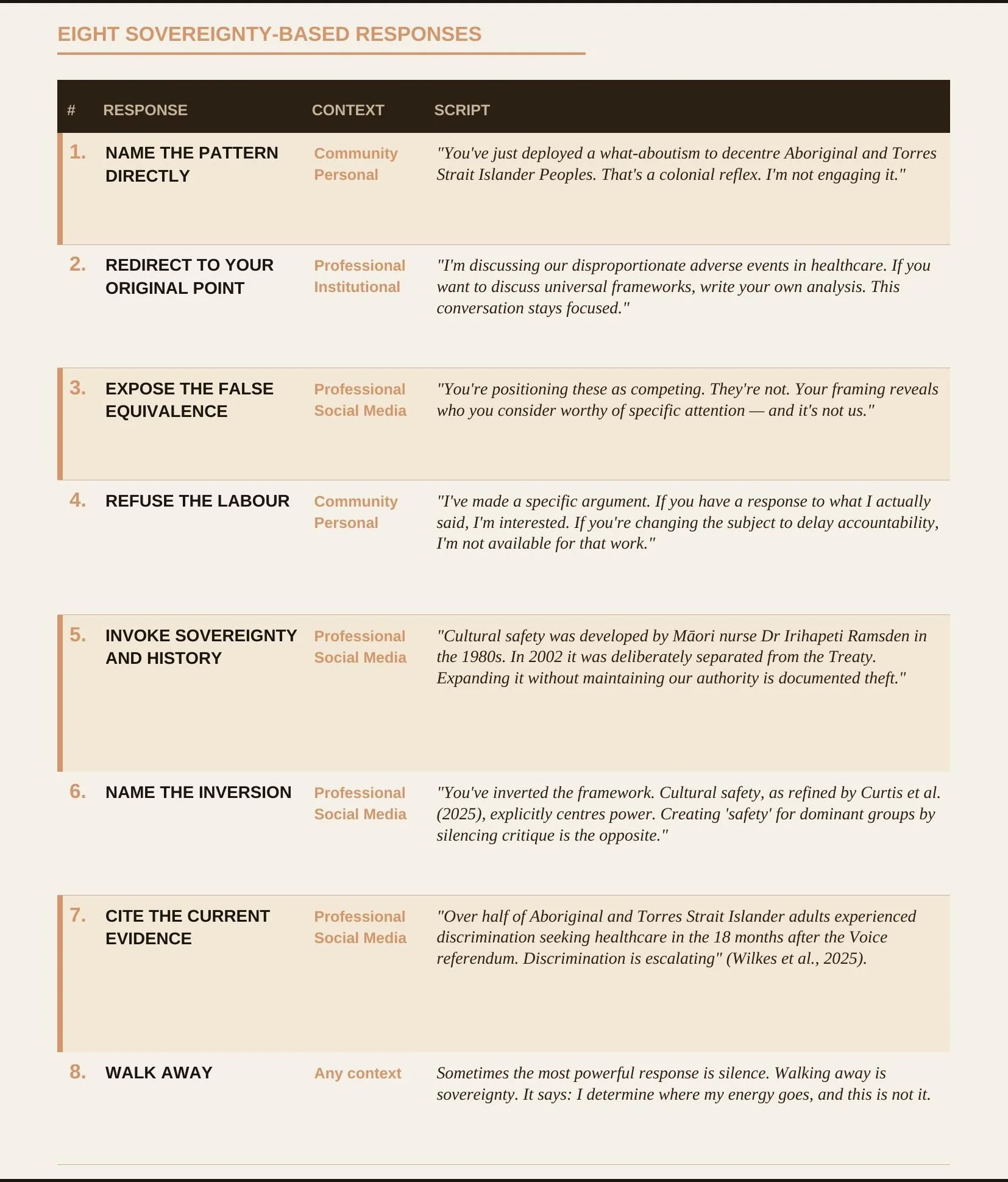
Sovereignty-Based Responses: What You Can Do
You are not obligated to engage every deflection. Your energy has value. Protect it. But when you choose to respond, here are frameworks grounded in sovereignty.
For Non-Indigenous People Reading This
When you respond to First Nations Peoples' specific analysis with what-aboutism, you are reasserting your authority to determine what gets discussed; protecting institutional comfort at the expense of accountability; positioning your discomfort as more urgent than documented harm; and performing thoughtfulness while preventing change. This is not allyship. This is colonial power protecting itself through your body.
Why You Do It
Scarcity Mindset
The scarcity logic examined earlier is worth naming directly here. You genuinely believe addressing Indigenous-specific harm takes something away from others. This is factually wrong - and it reveals you have never had to operate in systems that were not designed for you. When you have always been centred, specificity reads as exclusion.
White Acceptance As Structural Checkpoint
As Daniels names it: "white acceptance becomes the gateway to recognising and addressing racial harm" (2025, p. 6). When you ask, "What about other communities?" you are not being thorough. You are operating as a checkpoint, requiring First Nations Peoples to obtain your acceptance before their analysis can proceed. That is colonial power with good intentions, which produces the same outcomes as colonial power without them.
"Colour Blind" Institutional Racism
As Elias and Paradies show, "for institutional racism to thrive, people need only be 'colour blind,' 'meritocratic,' ignore the reality of existing privilege and injustices, and simply let the systems and structures reproduce the status quo" (2021, p. 47). Your neutrality is the problem.
White Possessiveness
As Moreton-Robinson (2015) explains, you've internalised proprietary rights over institutions and their frameworks. When First Nations Peoples assert sovereignty claims, it threatens that unconscious assumption.
Automated Colonial Reflex
You're doing what colonial systems trained you to do - diffuse, defer, dilute. This doesn't make you a bad person. It makes you someone operating from unexamined defaults.
What To Do Instead
— Sit with the discomfort of not being centred. When First Nations Peoples centre their own analysis, your job is to listen. Not balance. Not broaden. Listen.
— Recognise that specificity enables coalition. Coalition requires specificity, not false universality.
— Understand the history you’re erasing. De Souza (2026) documents the 2002 broadening as a deliberate deferral of Indigenous sovereignty claims. When you expand frameworks without maintaining our safety as paramount, you’re participating in documented theft.
— Acknowledge racism is escalating - the data is there. This happened while institutions were being “thoughtful” about avoiding the division of communities.
— When you notice the what-aboutism impulse, stop. Ask yourself: "Does this demonstrate engagement with what was actually said, or am I changing the subject?" If it's the latter - don't say it.
Your Authority Is Not In Question
For First Nations Peoples reading this: every time you experience whataboutism deflection, you are experiencing a sovereignty violation. Someone is asserting their authority to determine whether your analysis deserves specific attention.
Your authority is not in question. You do not need their permission to centre your community's safety.
When cultural safety gets co-opted, diluted, or universalised without Indigenous Peoples' authority determining what safety requires, that is theft. When the explicit power analysis gets removed, that is disarming. When it gets inverted so dominant groups claim they need "cultural safety" from your critique, that is gaslighting. When you're told your specific needs must be "balanced" against others, that is colonial logic encoded as equity.
That refusal - refusing to re-legitimise, refusing to justify, refusing to exhaust yourself proving what you already know - is sovereignty in action.
A Final Word to Institutions
The question facing institutions, regulators, and settler communities is not whether they agree with this analysis. They have read it. They have sat in the rooms where these deflections were deployed. They have watched the data accumulate and the frameworks dilute. The question is whether they will become the next exhibit in the next version of this article - or whether they will do the structural work their stated commitments require.
That work has a specific shape. It is not a workshop. It is not a policy commitment. It is the active, enforceable refusal to produce the deflections this article names - in every code review, every standard update, every room where someone asks why we can’t broaden the definition. The deflection has a name now. Using it is a choice.
Reference List
Ahpra. (2019). Ahpra Consultation Report on Cultural Safety Definition [Public Consultation]. Australian Health Practitioner Regulation Agency. https://www.ahpra.gov.au/documents/default.aspx?record=WD20%2f29578&dbid=AP&chksum=WNtpskiQJ01zHJQqObbIow%3d%3d
Australian Health Practitioner Regulation Agency. (2020). National Scheme’s Aboriginal and Torres Strait Islander Health and Cultural Safety Strategy 2020-2025. Australian Health Practitioner Regulation Agency. https://www.ahpra.gov.au/documents/default.aspx?record=WD20%2f29563&dbid=AP&chksum=7v438b3dSNNx%2bd9zleWRbA%3d%3d
Bond, C. J., Whop, L. J., Singh, D., & Kajlich, H. (2020). “Now we say Black Lives Matter but … the fact of the matter is, we just Black matter to them”1. Medical Journal of Australia, 213(6). https://www.mja.com.au/journal/2020/213/6/now-we-say-black-lives-matter-fact-matter-we-just-black-matter-them1
Curtis, E., Loring, B., Jones, R., Tipene-Leach, D., Walker, C., Paine, S.-J., & Reid, P. (2025). Refining the definitions of cultural safety, cultural competency and Indigenous health: Lessons from Aotearoa New Zealand. International Journal for Equity in Health, 24(1), 130. https://doi.org/10.1186/s12939-025-02478-3
Daniels, S. (2025). A Structural Companion Guide: For 30 Patterns of Harm: A Structural Review of Systemic Racism within the London Metropolitan Police Service. London Metropolitan Police Service. https://www.met.police.uk/SysSiteAssets/media/downloads/force-content/met/about-us/london-race-action-plan/a-structural-companion-guide.pdf
De Souza, R. (2026). On the misuse of Cultural Safety. Overland Literary Journal, 259(Feb/March 2026). https://overland.org.au/2026/02/on-the-misuse-of-cultural-safety/
Doherty, B., Evershed, N., & Shimada, Y. (2025, December 15). Visual explainer: How a night of terror unfolded in Bondi. The Guardian. https://www.theguardian.com/australia-news/2025/dec/15/a-visual-guide-to-the-bondi-beach-terror-attack
Fuller, J., Browning, M., Evans, J., & Balvin, N. (2024). How To Attract, Retain and Grow the Aboriginal and Torres Strait Islander Health Workforce in Australia: A self-determined approach: - ACHSM Asia-Pacific Health Leadership Congress in Brisbane 2024. Asia Pacific Journal of Health Management, 19(3), Article 3. https://doi.org/10.24083/apjhm.v19i3.4163
Moreton-Robinson, A. (2015). The white possessive: Property, power, and Indigenous sovereignty. University of Minnesota Press.
Murray, N. (2026, January 26). The question is no longer why the date should change, it is whether Australia has the courage to begin the next chapter in our nation’s story. National Indigenous Times. https://nit.com.au/26-01-2026/22302/the-question-is-no-longer-why-the-date-should-change-it-is-whether-australia-has-the-courage-to-begin-the-next-chapter-in-our-nations-story
Nursing and Midwifery Board of Australia. (2018, March 1). New codes of conduct take effect for nurses and midwives. https://www.nursingmidwiferyboard.gov.au/News/2018-03-01-new-codes.aspx
Papps, E., & Ramsden, I. (1996). Cultural Safety in Nursing: The New Zealand Experience. International Journal for Quality in Health Care, 8(5), 491–497. JSTOR.
Torre, G. (2026, February 17). Invasion Day bombing suspect named as suppression order deemed “not in the interests of justice.” National Indigenous Times. https://nit.com.au/17-02-2026/22718/invasion-day-bombing-suspect-named-as-suppression-order-deemed-not-in-the-interests-of-justice-alleged-terrorism
Watego, C. (2017, October 16). We just Black matter: Australia’s indifference to Aboriginal lives and land. The Conversation. https://doi.org/10.64628/AA.7js4rxn6t
Wilkes, B., Colonna, E., & McKay, C. (2025). Monitoring Aboriginal and Torres Strait Islander mental health and wellbeing around the Voice to Parliament Referendum. Yardhura Walani, ANU. https://yardhurawalani.com.au/wp-content/uploads/2025/12/Report_Tracking-wellbeing-18-months-post-Referendum.pdf
Wilkes, B., Whop, L., Thurber, K., Colonna, E., & Lovett, R. (2026). Embedding cultural safety to combat racism against Aboriginal and Torres Strait Islander peoples: Advice for healthcare settings. Australian Journal of General Practice, 55, 91–96.
Jayde Fuller is a Gamilaraay woman operating from Quandamooka Country. She is the founder of Indigenous Regulatory Practice and spent seven years in health practitioner regulation, including leading the work that embedded self-determination into the definition of cultural safety used across sixteen health professions in Australia's National Law. This article is an output of that practice.