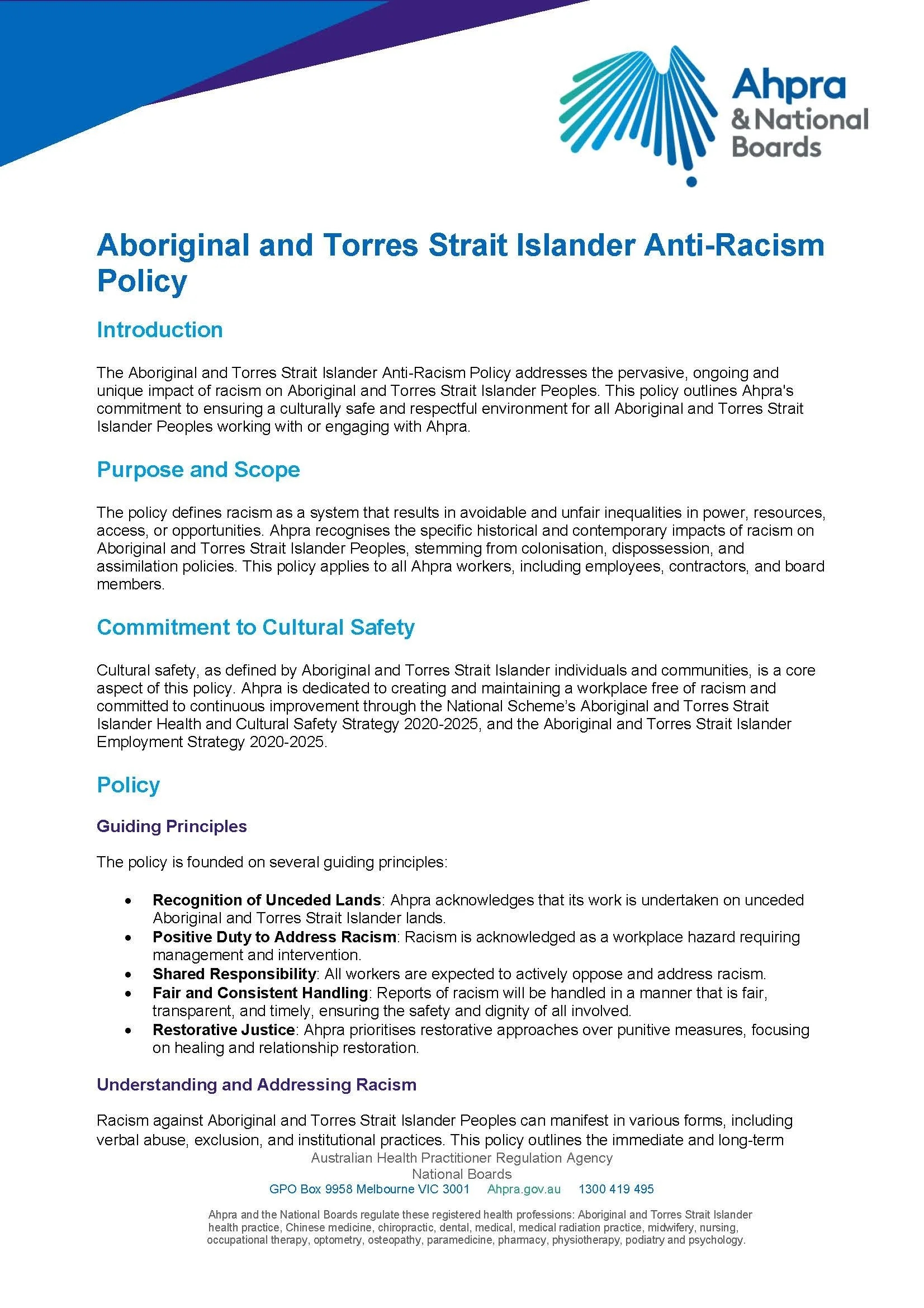
Anti-Racism Policy and Legislative Reform
Alongside the cultural safety strategy, I co-led the development of Ahpra's Aboriginal and Torres Strait Islander Anti-Racism Policy - a self-determined, transparent, Indigenous collectivist approach to complaints management relating to racism, developed by Wakaya race scholar Distinguished Professor Yin Paradies. International First Nations regulatory administrators have sought access to this policy for adoption in their own regulatory bodies.
The 2022 amendment of the National Law - which required tribunals and health regulatory decision-makers to take into account racist and culturally unsafe practices when deciding matters of professional misconduct - was a direct product of this body of work.
Its significance was demonstrated in October 2023, when the ACT Civil and Administrative Tribunal disqualified a Canberra GP from registration for twelve months following a racist email campaign targeting Yuggera, Warangoo and Wiradjuri ophthalmologist Associate Professor Kris Rallah-Baker - Australia's first Indigenous eye surgeon. The Medical Board of Australia described the tribunal's decision as a landmark outcome: the first case to reference the strengthened National Law provisions on cultural safety.
Responding publicly to the decision, I said: “This outcome is vindicating for Aboriginal and Torres Strait Islander Peoples whose experiences of racism in healthcare settings - as a consumer or practitioner - are minimised or refuted entirely.”
This body of work demonstrates that legislative and policy instruments - when designed with Indigenous knowledge sovereignty as the analytical foundation rather than compliance minimisation - can produce enforceable structural change at the national scale. Racism in healthcare practice is not a values problem. It is a regulatory problem. And regulatory problems have regulatory solutions.